
How to Play Family Feud in the Classroom: A Teacher’s Guide
There is a point in almost every review lesson when another worksheet stops being the answer.
Students know a test is coming.
You know they need to revise.
And enthusiasm for question number 27 is rapidly approaching zero.
That's where Family Feud can work surprisingly well.
The classroom version takes familiar lesson content and turns it into a team game. Instead of completing another list of questions individually, students discuss possible answers, retrieve information from memory and try to uncover the answers hidden on the classroom screen.
You can use it for:
lesson review;
test preparation;
vocabulary practice;
warm-ups;
speaking activities;
end-of-term lessons;
class rewards;
or simply making a familiar topic feel different.
And you don't need a television studio.
A teacher, two teams and a shared classroom screen are enough.

How Does Classroom Family Feud Work?
The basic idea is simple.
Two teams try to uncover answers hidden on a board.
The teacher asks a question such as:
Name something you might find in a science laboratory.
The board might contain:
Microscope — 30
Test tube — 25
Beaker — 18
Safety goggles — 12
Bunsen burner — 8
Students try to guess those answers.
A correct guess reveals the answer and adds its value to the round.
An incorrect guess earns a strike.
After three strikes, the opposing team can get an opportunity to steal.
The team winning the round receives the points.
Then you move to the next question.
That's the game.
The educational value comes from what you put on the board and what you do between guesses.
What Do You Need to Play Family Feud in Class?
At minimum:
Two teams
Divide your class approximately in half.
A host
Usually you.
Although older students can host later.
Questions and answers
Use general classroom questions, educational questions or your own lesson content.
A visible game board
Use your projector, interactive whiteboard, television or another shared classroom display.
A way to keep score
This can be manual or built into the game system you're using.
You do not need every student to have a phone, tablet or Chromebook.
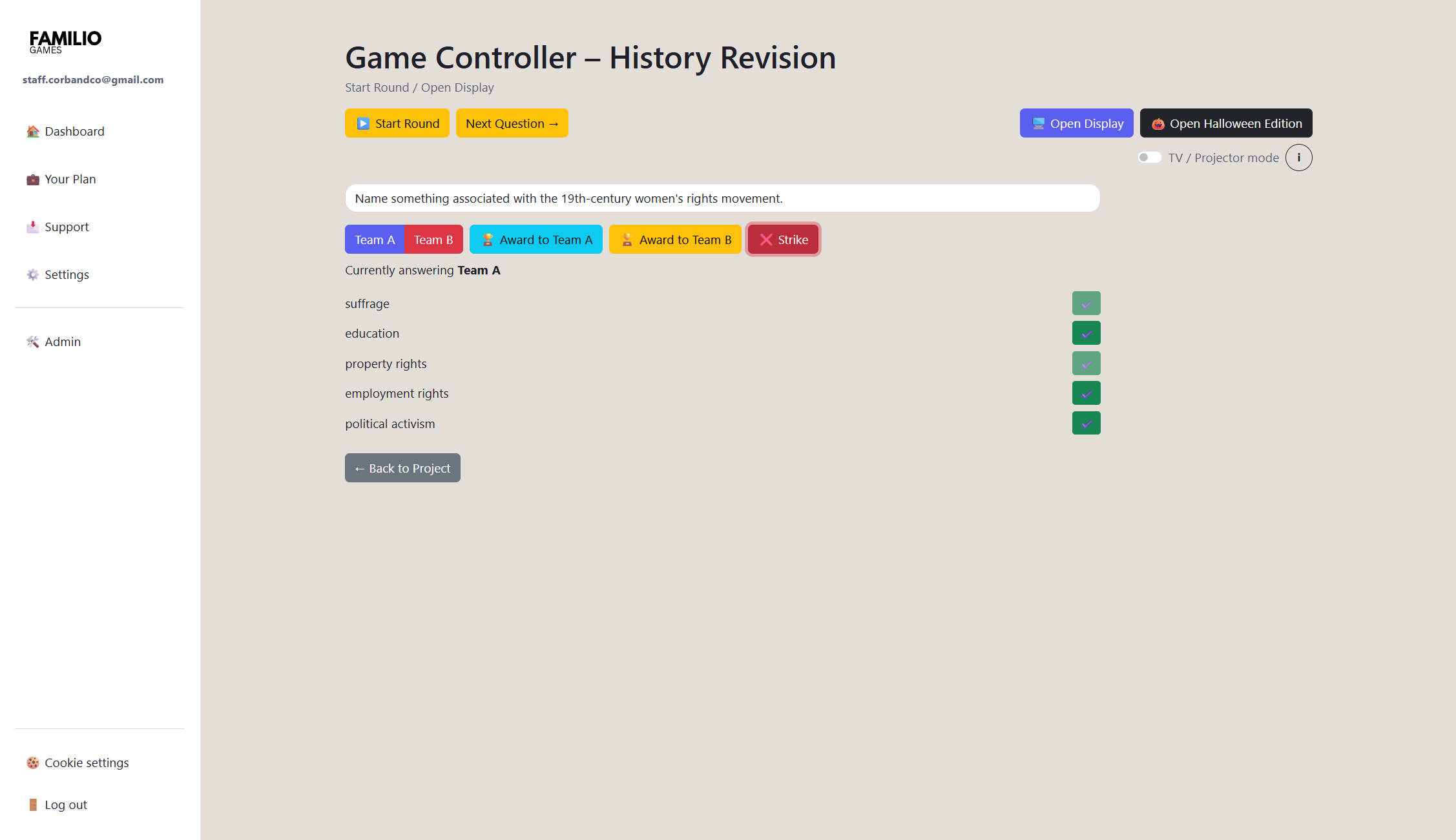
With Familio Games' Family Feud for Classroom & School setup, the teacher can keep the controller privately on one laptop while students follow a separate audience display on the classroom projector or interactive board.
How to Set Up Classroom Family Feud Step by Step
Let's build a complete game.
Step 1: Decide What the Game Is For
Start with the learning goal.
Are you using Family Feud for:
revision?
vocabulary?
a warm-up?
speaking practice?
general knowledge?
an end-of-term activity?
This determines the questions.
A Friday activity can use lighter general questions.
A revision lesson should use material students actually need to retrieve.
Step 2: Prepare Your Questions
A good classroom Family Feud question needs several plausible answers.
For example:
Name a European capital city.
works.
So does:
Name a type of triangle.
But:
What is the capital of France?
doesn't work particularly well as Family Feud.
That's trivia.
There is one correct answer.
Family Feud works best when students are trying to identify multiple answers that belong to the same question.
Step 3: Divide the Class Into Two Teams
You don't need five students per team just because that's familiar from television.
If you have 28 students, create two teams of 14.
If you have 18, create two teams of nine.
For a very large class, keep two main teams and rotate the active representatives.
The important thing is that students understand which side they belong to.
Step 4: Explain the Rules Before Starting
Do this while everyone is still listening.
Explain:
correct guess = reveal an answer;
wrong guess = strike;
three strikes = other team can steal;
winning team receives the round points.
Then play one easy practice question.
A practice round solves more confusion than five minutes of additional explanation.
Step 5: Put the Game Board on the Classroom Screen
Students should see:
the question;
revealed answers;
strikes;
round points;
and team scores.
They should not see the hidden answers or your hosting controls.
A two-screen setup works particularly well here.
The teacher keeps the private controller on the laptop.
Students see only the audience display on the projector or interactive board.
Step 6: Start the Face-Off
Choose one representative from each team.
Read the question.
Students can compete using:
raised hands;
a classroom buzzer;
a desk bell;
or another clear signal.
You don't need specialized buzzers.
Raised hands work perfectly well.
Step 7: Play the Board
The team in control starts guessing.
Rotate through students rather than allowing one confident player to answer repeatedly.
When a correct answer is given, reveal it.
When the answer isn't there, add a strike.
Step 8: Give the Other Team a Chance to Steal
After three strikes, allow the opposing team a brief discussion.
They give one answer.
If it appears on the board, they steal the round.
If not, the original team keeps the points.
Step 9: Award the Points and Move On
Don't let the transition between rounds take longer than the actual game.
Award the points.
Choose new representatives.
Next question.
Keep the pace moving.
Classroom Family Feud Rules — The Simple Version
You do not need to reproduce television rules perfectly.
For school, I recommend:
Two teams.
One face-off at the beginning of each round.
Students answer in rotation.
Three incorrect answers = three strikes.
After three strikes, the other team gets one steal attempt.
Winning team receives the round points.
Highest total at the end wins.
That's enough.
The objective is student participation and learning.
Not producing a legally accurate recreation of a television episode.
How Should Family Feud Points Work?
There are two sensible approaches.
Option 1: Ranked Point Values
Give likely or stronger answers higher values.
For example:
Name a European capital.
Paris — 30
Rome — 25
Madrid — 20
Berlin — 15
Vienna — 10
This creates the familiar Family Feud feel.
If you haven't actually surveyed people, don't describe these values as results from “100 people surveyed.”
They're simply suggested gameplay points.
Option 2: Equal Points
For younger students or pure revision, make every valid answer worth the same amount.
This is less authentic to Family Feud but extremely easy to understand.
For classroom learning, simplicity sometimes matters more than perfect format accuracy.
20 Family Feud Question Ideas for the Classroom
Here are examples you can adapt.
English / Language Arts
1. Name a part of speech.
Noun, verb, adjective, adverb, pronoun.
2. Name a type of story.
Mystery, fantasy, adventure, romance, science fiction.
3. Name something you need to write a good story.
Characters, plot, setting, conflict, ending.
4. Name a word that can describe a person.
Friendly, funny, kind, intelligent, helpful.
Science
5. Name something you might find in a science laboratory.
Microscope, test tube, beaker, safety goggles, Bunsen burner.
6. Name a planet in our solar system.
Earth, Mars, Jupiter, Venus, Saturn.
7. Name an animal that is nocturnal.
Bat, owl, fox, hedgehog, moth.
8. Name a source of energy.
Solar, wind, fossil fuels, hydroelectric, nuclear.
Geography
9. Name a country in Europe.
France, Germany, Italy, Spain, Poland.
10. Name a European capital.
Paris, Rome, Madrid, Berlin, Warsaw.
11. Name something you might find on a map.
Country, city, river, road, border.
12. Name a continent.
Europe, Asia, Africa, North America, South America.
History
13. Name something associated with Ancient Egypt.
Pyramids, pharaohs, mummies, Nile, hieroglyphics.
14. Name something you might find in a medieval castle.
Knight, king, tower, armour, dungeon.
15. Name a reason people study history.
Understand the past, learn from mistakes, understand cultures, study change, understand the present.
Mathematics
16. Name a type of triangle.
Equilateral, isosceles, scalene, right, acute.
17. Name something you can measure.
Length, weight, time, temperature, volume.
18. Name a shape with four sides.
Square, rectangle, rhombus, trapezoid, parallelogram.
General Classroom
19. Name something students keep in a backpack.
Books, pens, notebooks, lunch, pencil case.
20. Name something students do before a test.
Study, revise, worry, ask questions, practise.

Should You Survey Students for the Answers?
You can.
And it can become an activity by itself.
Before the game, give another class or group several survey questions.
For example:
Name the hardest school subject.
Name something students forget to bring to class.
Name the best thing about Friday.
Collect the responses.
Rank the most common answers.
Now you have genuine survey data for your Family Feud boards.
Students can even:
collect responses;
calculate frequencies;
create charts;
rank answers;
and convert the results into point values.
Suddenly Family Feud becomes a statistics activity.
But you don't need survey data every time.
For normal lesson review, teacher-created answers with suggested point values work perfectly well.
How to Use Family Feud for Test Review
This is probably one of the most useful classroom applications.
Instead of asking:
“What topics do we need to revise?”
turn each topic into a board.
Imagine students are preparing for a geography test.
Round 1:
Name a country bordering Germany.
Round 2:
Name a European river.
Round 3:
Name a type of climate.
Round 4:
Name a renewable source of energy.
After revealing each answer, don't immediately jump to the next guess.
Ask a follow-up.
For example:
“Where is the Danube?”
or:
“Why is wind considered renewable?”
The game provides retrieval.
Your follow-up provides the teaching.
That's an important distinction.
Family Feud shouldn't replace explanation.
It should create opportunities for it.
How to Use Family Feud for Vocabulary
Family Feud works particularly well in language lessons because many vocabulary categories naturally have multiple answers.
Try:
Name something found in a kitchen.
Name a verb connected with travel.
Name an adjective describing personality.
Name something people do at the weekend.
Name a job that requires a uniform.
Then increase the language requirement.
Beginner
Student says:
“Doctor.”
Accept it.
Intermediate
Require:
“I think doctor is on the board.”
Advanced
Require:
“Our team thinks doctor will be one of the most common answers because…”
The game remains the same.
The language demand changes.
How to Use Family Feud for Math
Math requires slightly more careful question design.
Avoid questions with only one mathematically correct solution.
Instead use categories.
For example:
Name a prime number below 20.
Name a type of angle.
Name something measured in centimetres.
Name a shape with four sides.
Name a multiple of six below 50.
After revealing an answer, ask students to explain it.
If someone guesses:
24
for a multiple of six, ask:
“How do we know?”
Now the answer becomes retrieval plus explanation.
How to Use Family Feud for Science
Science works extremely well because most topics contain categories.
Try:
Name a mammal.
Name a state of matter.
Name something a plant needs to grow.
Name an organ in the human body.
Name a renewable source of energy.
Name something found in a laboratory.
You can make the questions increasingly specific as students get older.
How to Use Family Feud for History
History questions should encourage retrieval without reducing complex history to meaningless popularity contests.
Good:
Name something associated with Ancient Rome.
Name a cause of World War I.
Name an invention that changed transportation.
Less useful:
Name the best historical leader.
Unless your actual objective is debate.
Use the board to retrieve information.
Then discuss why each answer matters.
How to Use Family Feud for ESL and Foreign Languages
This may be one of the strongest uses of the format.
Students need vocabulary.
Family Feud requires vocabulary.
But unlike flashcards, the vocabulary appears inside a competitive social activity.
Use categories such as:
Food
Travel
School
Jobs
Animals
Clothing
Weather
Personality
Daily routines
Then require answers in the target language.
You can also use the revealed board afterward for:
sentence creation;
pronunciation;
spelling;
comparatives;
past tense;
or discussion.
How Many Questions Do You Need?
Less than you probably think.
10-Minute Warm-Up
Prepare 2–3 questions.
Skip elaborate face-offs if necessary.
Play quickly.
20-Minute Review
Prepare approximately 4–6 questions.
Mix easy and difficult boards.
45-Minute Lesson
Prepare around 8–10 questions.
That leaves time for:
instructions;
discussion;
follow-up teaching;
scoring;
and transitions.
You don't need twenty boards simply because you have twenty questions available.
Finish while students still want another round.
A Ready-to-Use 45-Minute Family Feud Lesson Plan
Here's a simple structure.
0–5 Minutes — Setup
Split the class into two teams.
Explain:
answers;
strikes;
steals;
scoring.
Play one easy practice question.
5–15 Minutes — Warm-Up Rounds
Use two or three accessible questions.
Build confidence.
Let students understand the format.
15–35 Minutes — Main Revision
Use subject-specific questions.
After important answers, pause briefly for explanation or discussion.
Rotate representatives.
35–42 Minutes — Challenge Round
Use one or two more difficult questions.
Double the points if you want extra tension.
42–45 Minutes — Final Score and Review
Reveal the winner.
Then ask:
“What did we revise today?”
The game should still end as a lesson.
Not merely as a scoreboard.
How to Keep Every Student Involved
This is where classroom Family Feud succeeds or fails.
If you simply say:
“Who knows an answer?”
the same students will dominate.
Instead:
Rotate Face-Off Players
Nobody gets a second face-off until everyone willing to participate has had an opportunity.
Use Answering Order
Move down the team systematically.
Now students know their turn is coming.
Allow Brief Team Discussion
Give teams five or ten seconds before selected questions.
Quiet students can contribute without speaking to the whole class.
Use a Team Spokesperson
For students uncomfortable speaking publicly, allow them to give their idea to the spokesperson.
Give Students Jobs
In a large class, students can also become:
score assistants;
team captains;
timekeepers;
judges;
or question writers.
Participation doesn't always require standing at the front.
How to Play Family Feud With a Large Class
Thirty students?
Still fine.
Forty?
Possible.
Don't create eight tiny teams unless you really need to.
Two large teams keep the game understandable.
Rotate representatives.
Allow short discussion periods.
Use the classroom screen as the shared focus.
With very large groups, create rows or smaller discussion units inside each main team.
Each unit suggests an answer to the team's current representative.
That lets more students think without having 38 people shouting simultaneously.
What About Shy or Anxious Students?
Don't force every student into a public face-off.
The objective is participation, not discomfort.
Students can contribute through:
team discussion;
written suggestions;
small-group brainstorming;
question creation;
scorekeeping;
or acting as a team adviser.
As confidence increases, some students may choose to take a more visible role.
A classroom game should lower the barrier to participating.
Not create another one.
How to Handle Shouting Out Answers
Set this rule before question one:
Only the active player or designated spokesperson can submit an answer.
If teammates shout an answer publicly, decide in advance what happens.
You might:
ignore it;
count it as unavailable for that turn;
or give the other team control.
The exact consequence matters less than consistency.
Once students realize shouting helps their opponents hear answers, teams often begin policing themselves remarkably efficiently.
How Long Should Students Get to Answer?
Don't let every guess become a committee meeting.
A reasonable classroom rhythm is:
5–10 seconds for an individual answer
and
10–20 seconds for a team discussion before a steal.
For younger students or language learners, allow more time.
For quick revision, shorten it.
The timer exists to maintain pace.
Not create panic.
Can Students Create Their Own Family Feud Questions?
Absolutely.
This is one of the strongest extensions of the activity.
Give small groups a topic.
For example:
The Solar System
Ancient Egypt
Irregular Verbs
European Geography
Each group creates:
one question;
four to six plausible answers;
and suggested point values.
Then play the best student-created boards with the class.
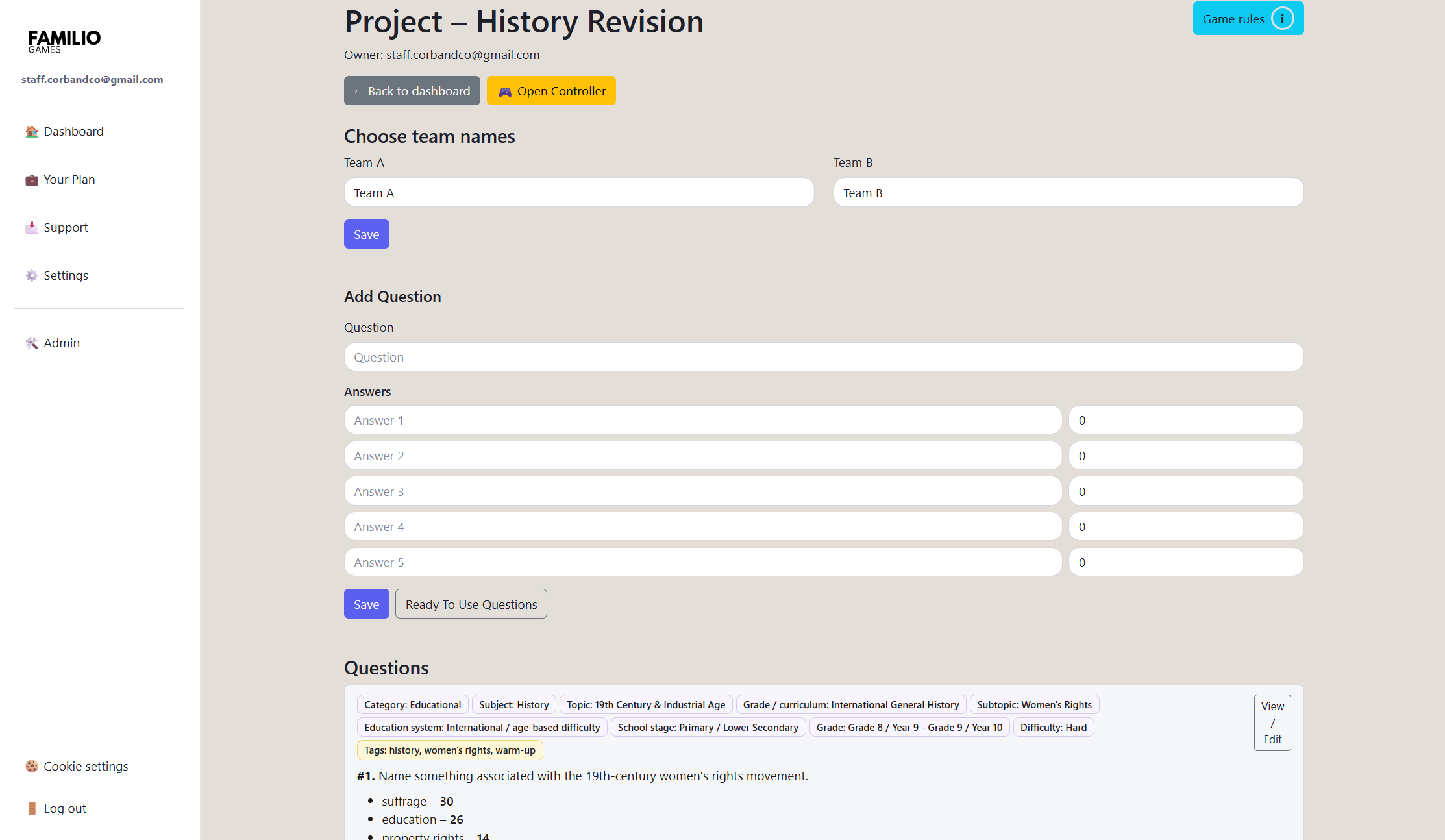
Familio Games lets teachers create custom questions, answers and point values, so these student-created rounds can be added directly to a classroom project.
Students aren't merely recalling information anymore.
They're deciding:
Which answers are valid?
Which are most obvious?
Which deserve higher values?
What might another student say?
That's a much deeper task than filling in a blank.
Ready-Made Questions vs Custom Questions
You don't have to choose one approach.
Ready-Made Questions
Best when:
you need something quickly;
the game is a reward;
you're running a general-knowledge activity;
or you want an easy warm-up.
Custom Questions
Best when:
you're revising a specific unit;
you need curriculum-aligned content;
you're teaching vocabulary;
or you want questions based on your exact class.
Mix Both
Often the strongest lesson uses both.
Start with a fun general question.
Move into lesson content.
Finish with something lighter.
Students get the game-show experience without every question feeling like a disguised exam.
Do You Need PowerPoint?
No.
You certainly can build classroom Family Feud in PowerPoint or Google Slides.
But then you need to manage things such as:
hidden answers;
answer reveals;
scores;
strikes;
question changes;
and potentially animations.
That can work well if you've already built the template.
If you're starting from scratch, a browser-based classroom game can remove much of that preparation.
Familio Games keeps questions, answer reveals, strikes, scores, teacher controls and the student-facing board in the same hosting flow.
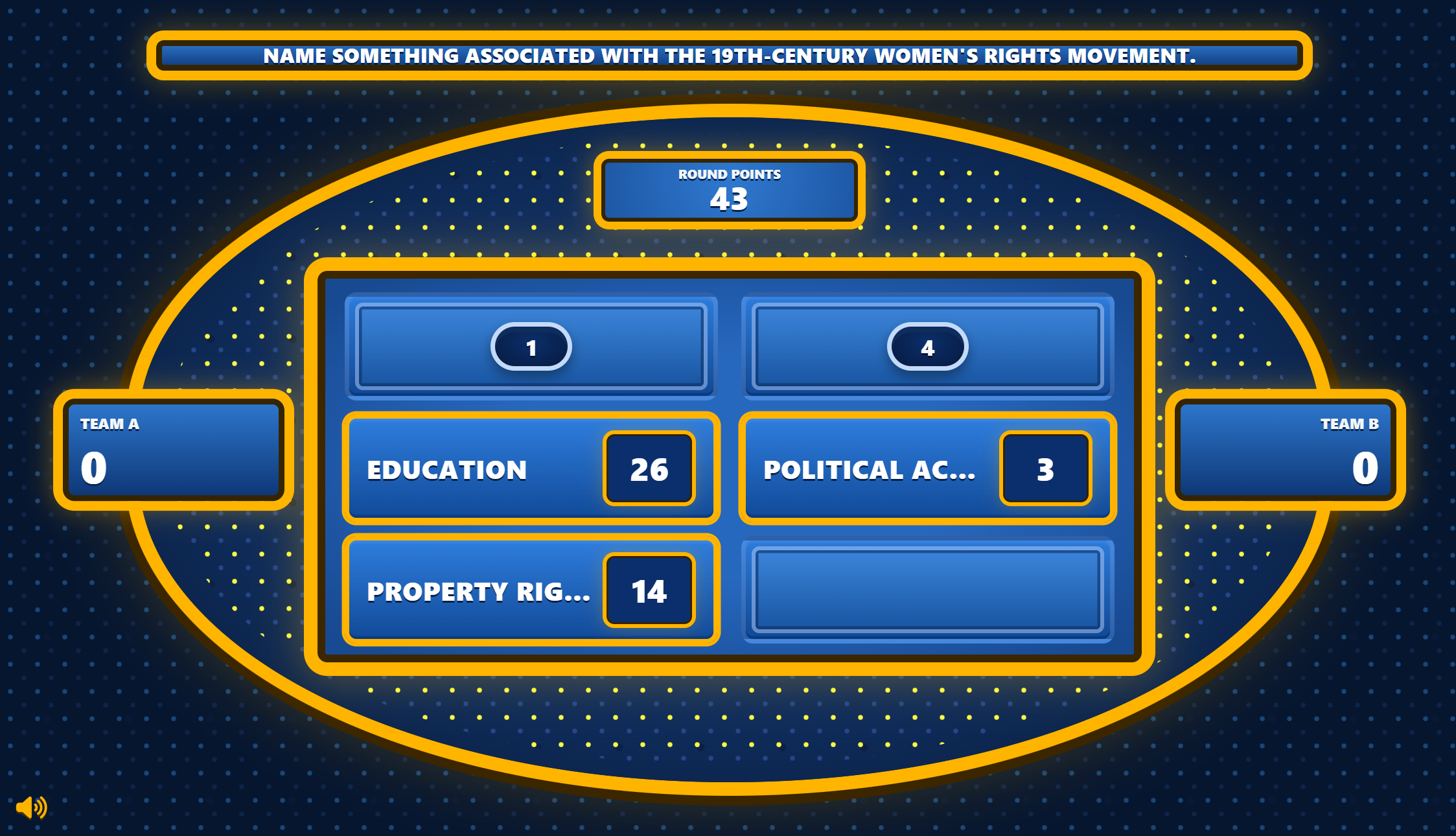
The teacher controls the game privately.
Students see the board.
That's the important separation.
Can Students Play Without Their Own Devices?
Yes.
And for many classrooms, that's actually simpler.
With the shared-screen approach:
Teacher: laptop/controller.
Class: projector, TV or interactive whiteboard.
Students: no devices required.
Students answer verbally, through raised hands, buzzers or team representatives.
This means you don't have to spend the beginning of the lesson solving:
dead Chromebook batteries;
forgotten passwords;
QR-code problems;
Wi-Fi issues;
or the mysterious student who has somehow opened YouTube instead.
One shared classroom display is enough.
Can You Play Family Feud Online or Remotely?
Yes.
For remote teaching, keep the controller private and share only the audience-facing game board through your video-call screen share.
Students can discuss answers verbally or in team breakout rooms.
Our guide to hosting Family Feud online explains the broader two-screen and remote-hosting setup.
Family Feud for Different Age Groups
Elementary / Primary School
Keep questions concrete.
Use fewer answers.
Allow more discussion time.
Examples:
Name a farm animal.
Name something yellow.
Name something in a classroom.
Avoid long elimination.
Middle School
Introduce categories, strategy and humour.
Examples:
Name something students forget at home.
Name a renewable energy source.
Name something associated with Ancient Egypt.
Let students create questions too.
High School
Use more challenging curriculum content.
Ask students to explain answers after revealing them.
Use student-generated boards.
Family Feud doesn't have to feel childish.
The game-show format is simply the structure.
The intellectual level comes from your questions.
Family Feud as a Warm-Up, Review or Reward
The same format can serve very different purposes.
Warm-Up
Two quick boards.
Five to ten minutes.
Activate prior knowledge.
Review
Subject-specific questions.
Follow-up explanations.
Twenty to forty minutes.
Reward
Lighter questions.
Student-created rounds.
End of week or term.
School Event
Larger teams.
Projector.
Student host.
Longer game.
The mechanics stay familiar.
Only the content and scale change.
Halloween, Christmas and Seasonal Classroom Family Feud
Once students understand the format, seasonal versions require almost no additional explanation.
For Halloween, you can use spooky vocabulary, autumn topics and Halloween questions. Our Halloween Family Feud for the Classroom guide includes seasonal rules, teacher tips and ready-to-use rounds.
You can also combine Family Feud with other Halloween classroom games when you're planning a full classroom party or activity lesson.
The same approach works for Christmas, end-of-year lessons, back-to-school activities and other seasonal events.
Common Classroom Family Feud Mistakes
Making Every Question Too Difficult
Students need early success.
Start accessible.
Increase difficulty gradually.
Letting the Same Students Answer Everything
Use rotation.
Preparing Too Many Questions
Eight good boards are more useful than twenty rushed ones.
Treating Every Answer as a Debate
Decide quickly whether a response matches.
Be consistent.
Move on.
Forgetting the Learning Goal
If the game is review, pause occasionally and actually review.
Points alone don't teach the lesson.
Eliminating Students
Avoid formats where half the class spends twenty minutes watching.
Teams solve that problem.
Why Family Feud Works Well for Review
Traditional quiz questions often ask:
Do you know the answer?
Family Feud-style questions can ask something slightly different:
How many relevant answers can you retrieve?
That makes categories particularly useful.
Students brainstorm.
Compare possibilities.
Retrieve vocabulary.
Discuss relevance.
And see additional answers revealed even when they didn't think of them themselves.
The competitive structure provides the motivation.
The discussion around the board provides much of the educational value.
Ready to Try Family Feud in Your Classroom?
You don't need individual student accounts.
You don't need a complicated PowerPoint.
And you don't need a television studio.
Choose your topic.
Prepare a handful of questions.
Divide the class into two teams.
Put the board on the classroom screen.
Then start the first face-off.
With Familio Games, teachers can use ready-to-play questions or create their own educational rounds, keep answers and controls private on the teacher laptop and show students a separate live game board on the classroom projector or interactive display.
Use it for five-minute warm-ups.
Build a full revision lesson.
Let students create their own questions.
Or save it for the Friday afternoon when another worksheet is clearly not going to win.
Create your classroom Family Feud game with Familio Games.
Frequently Asked Questions
How do you play Family Feud in the classroom?
Divide the class into two teams. Ask a question with several hidden answers. Students try to reveal those answers, with correct guesses earning points and incorrect guesses earning strikes. After three strikes, the opposing team can attempt to steal the round.
How many students can play classroom Family Feud?
The format can work with small groups or classes of 30–40 students. For larger classes, use two main teams and rotate active representatives rather than creating many separate teams.
How many Family Feud questions do I need for a lesson?
Around 2–3 questions can work for a ten-minute warm-up, 4–6 for a 20-minute review and approximately 8–10 for a full 45-minute lesson with discussion and explanation.
What subjects can you use Family Feud for?
Family Feud can be adapted for English, ESL, mathematics, science, geography, history, general knowledge and many other subjects by creating questions with several plausible answers.
Can I create my own Family Feud questions for students?
Yes. Teachers can create subject-specific questions, answers and point values around their own lesson or curriculum.
Do students need phones or Chromebooks?
No. Classroom Family Feud can be played with one teacher device and one shared projector, television or interactive whiteboard. Students can answer verbally or through team representatives.
Do I need PowerPoint to play Family Feud at school?
No. You can build the game manually in PowerPoint or Slides, but browser-based tools can handle answer reveals, strikes, scoring and the audience display without requiring you to build the presentation yourself.
Can Family Feud be used for test review?
Yes. Subject-specific Family Feud boards can be used for retrieval practice before quizzes and tests. Teachers can also pause after answers are revealed to explain concepts or ask follow-up questions.
Can students create Family Feud questions?
Yes. Asking students to create questions, possible answers and suggested point values can turn the activity into a deeper review task.
Can I play classroom Family Feud on a projector or interactive whiteboard?
Yes. Familio Games provides a separate audience display that can be placed on a projector, television or classroom display while the teacher keeps the controller and hidden answers private.
Where can I find Halloween Family Feud questions for school?
Our Halloween Family Feud for the Classroom guide includes classroom-specific setup advice and seasonal questions, while our collection of Halloween classroom games includes Family Feud alongside other learning, movement and low-prep activities.