25 Halloween Classroom Games Students Will Actually Enjoy
Halloween classroom games have one job that Halloween party games at home don't:
They have to survive an actual classroom.
That means limited space.
Twenty or thirty students.
A fixed lesson time.
Different personalities.
School rules.
And a bell that absolutely does not care whether your final round is finished.
So the best Halloween classroom game isn't necessarily the most elaborate one.
It's the one students enjoy and you can actually manage.
Below you'll find 25 Halloween classroom games for different ages, spaces and energy levels — from five-minute vocabulary activities to full-class team games.
Most require little preparation.
Several can become genuine learning activities.
And none require you to transform your classroom into a haunted theme park.
Halloween Classroom Games at a Glance
GameBest forTimePrepEnergyLearningHalloween Family FeudGrades 3–1215–40 minLowMedium★★★Halloween 5 Second RuleGrades 3–1210–20 minLowMedium★★★Halloween PictionaryGrades 2–1215–25 minVery lowMedium★★★Halloween CharadesGrades 2–1010–20 minLowHigh★★Halloween BingoGrades K–615–25 minMediumLow★★Halloween Would You RatherGrades 2–125–15 minNoneLow★★★Four CornersGrades 2–1010–15 minVery lowHigh★★Halloween TriviaGrades 4–1215–30 minLowMedium★★★Spooky Vocabulary RaceGrades 3–1210–15 minVery lowMedium★★★Mystery BoxGrades K–615–25 minMediumMedium★★Monster Freeze DanceGrades K–45–15 minVery lowHigh★Halloween Scavenger HuntGrades 1–815–30 minMediumHigh★★Draw the MonsterGrades K–810–20 minLowLow★★★Halloween Story ChainGrades 3–1210–25 minNoneLow★★★Guess the Halloween SoundGrades K–610–15 minLowLow★★Pumpkin Math ChallengeGrades 1–815–30 minMediumLow★★★Halloween CategoriesGrades 3–1210–20 minNoneMedium★★★Who Am I? HalloweenGrades 3–1215–20 minLowMedium★★Halloween Word ScrambleGrades 2–810–15 minLowLow★★★Spooky Sentence ChallengeGrades 3–1210–20 minNoneLow★★★Pumpkin RelayGrades 1–610–20 minLowHigh★Halloween Memory GameGrades K–610–20 minLowLow★★Guess the Teacher's AnswerGrades 3–1210–20 minNoneMedium★★Halloween DebateGrades 6–1215–30 minNoneMedium★★★Create Your Own Game ShowGrades 5–1225–45 minLowMedium★★★
Don't try to use all 25.
For most lessons, two or three well-chosen games are better than seven rushed ones.
1. Halloween Family Feud
Best for: Grades 3–12
Time: 15–40 minutes
Prep: Low
Energy: Medium
Learning potential: High
Divide the class into two teams.
Show students a question such as:
Name something you might find in a haunted house.
Several answers are hidden on the board.
Students try to predict them.
Correct answers score points. Incorrect guesses earn strikes. After three strikes, the opposing team can attempt to steal the round.
What makes the format useful in school is that the questions don't have to be purely Halloween-related.
An English teacher could ask:
Name an adjective that describes a haunted house.
A science teacher:
Name an animal that is nocturnal.
A geography teacher:
Name a country in Europe.
You can therefore keep the Halloween atmosphere while turning the game into actual lesson review.
Familio Games' classroom setup lets the teacher keep the controller and answers privately on a laptop while students see the game board on a projector or classroom display.
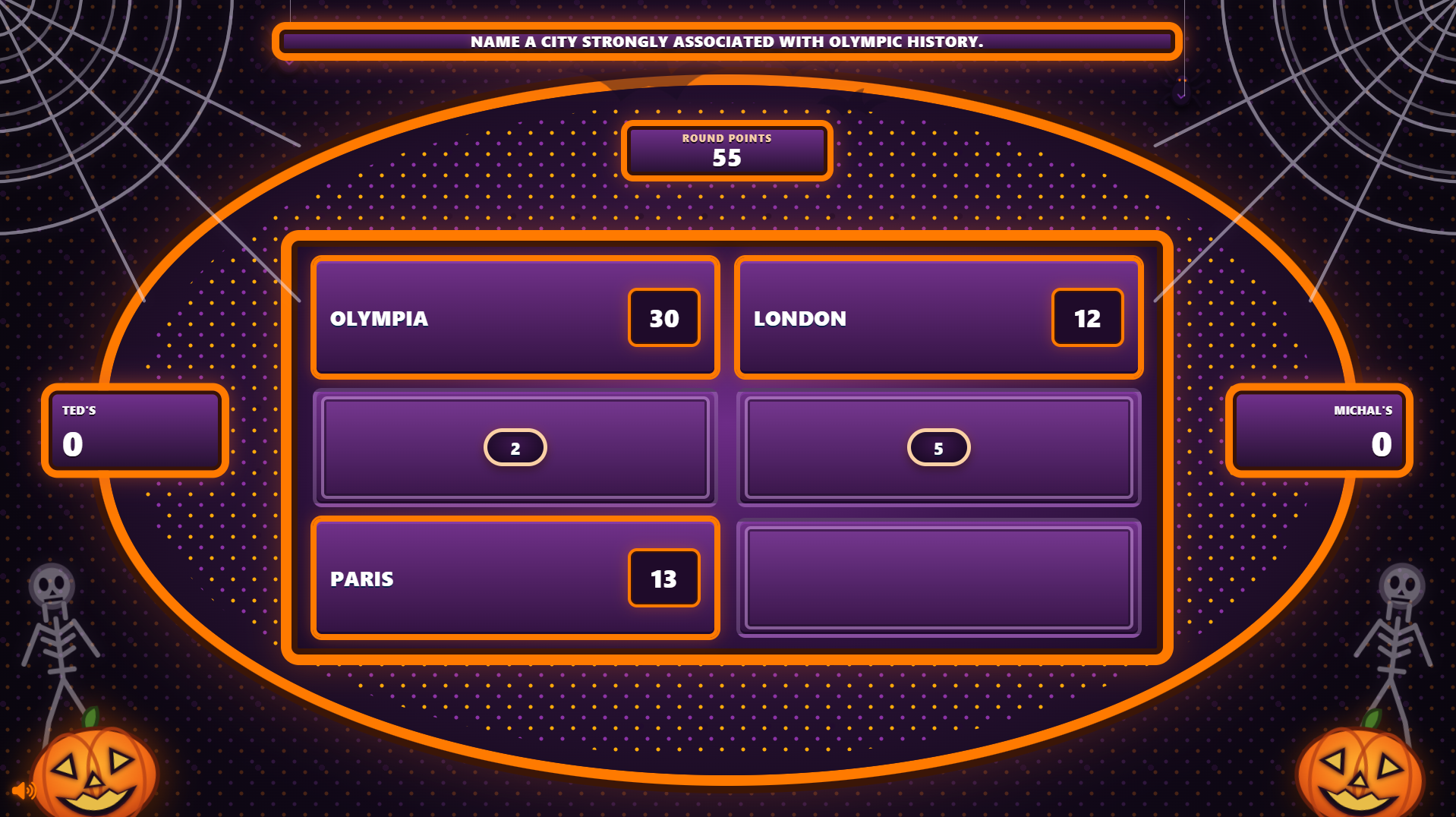
For the full setup, classroom rules, age adaptations and ready-to-use questions, see our Halloween Family Feud for the Classroom guide.
Why students enjoy it: Teams, hidden answers, points and strikes create genuine anticipation.
Teacher tip: Rotate representatives so the same confident students don't answer every round.
2. Halloween 5 Second Rule
Best for: Grades 3–12
Time: 10–20 minutes
Prep: Low
Energy: Medium
Learning potential: High
Give a student five seconds to name three things.
For example:
Name three Halloween costumes.
Name three things associated with witches.
Name three nocturnal animals.
Name three adjectives describing a haunted house.
The timer turns even simple questions into a challenge.
For language classes, require answers in the target language.
For lesson review, replace Halloween prompts with subject-specific categories.
Teacher tip: Play in teams rather than eliminating individual students.
3. Halloween Pictionary
Best for: Grades 2–12
Time: 15–25 minutes
Prep: Very low
Energy: Medium
Learning potential: High
Prepare Halloween words such as:
pumpkin, vampire, haunted house, broomstick, skeleton, spider, ghost and cauldron.
One student draws while their team guesses.
For language lessons, students must say the word correctly before earning the point.
For older students, use concepts rather than objects.
Try:
superstition
fear
suspense
mystery
Terrible drawing ability is not a disadvantage.
It may actually improve the game.
4. Halloween Charades
Best for: Grades 2–10
Time: 10–20 minutes
Prep: Low
Energy: High
Students act out Halloween words or actions without speaking.
Try:
zombie walking
witch flying
carving a pumpkin
running from a ghost
trick-or-treating
Keep rounds short.
Students waiting twenty minutes for their turn are not playing charades.
They're watching charades.
5. Halloween Bingo
Best for: Grades K–6
Time: 15–25 minutes
Prep: Medium
Energy: Low
Create cards using Halloween pictures or vocabulary.
Include:
pumpkin, bat, witch, ghost, spider, candy, skeleton, broomstick and black cat.
For language learners, call definitions instead of words.
Instead of:
“Pumpkin.”
say:
“A large orange vegetable often carved at Halloween.”
Students now have to understand the clue before finding the answer.
Teacher tip: Use reusable counters instead of candy if food isn't appropriate for your classroom.
6. Halloween Would You Rather
Best for: Grades 2–12
Time: 5–15 minutes
Prep: None
Energy: Low to medium
Learning potential: High
Ask students questions such as:
Would you rather explore a haunted house or a dark forest?
Would you rather be a vampire or a werewolf?
Would you rather have a pet bat or a pet spider?
Students vote with raised hands or move to different sides of the classroom.
Then ask:
Why?
That one word turns a voting game into a speaking exercise.
For language classes, require a full sentence:
“I would rather explore the haunted house because…”
7. Halloween Four Corners
Best for: Grades 2–10
Time: 10–15 minutes
Prep: Very low
Energy: High
Assign four answers to four corners of the classroom.
Ask:
Which Halloween creature would you rather be?
Corner 1: Vampire
Corner 2: Witch
Corner 3: Ghost
Corner 4: Werewolf
Students move to their choice.
Choose several students to explain their decision.
This works particularly well when the class needs movement after sitting for a long period.
8. Halloween Trivia
Best for: Grades 4–12
Time: 15–30 minutes
Prep: Low
Energy: Medium
Learning potential: High
Prepare questions covering several categories:
Halloween traditions.
Animals.
Autumn.
History.
Books.
Movies.
Science.
Don't make every question obscure.
A classroom trivia game works best when most teams can answer some questions and difficult questions create occasional surprises.
For older students, let teams write one question for the opposing team.
9. Spooky Vocabulary Race
Best for: Grades 3–12
Time: 10–15 minutes
Prep: Very low
Energy: Medium
Learning potential: High
Write a category on the board:
Things associated with Halloween
Teams have one minute to write as many relevant words as possible.
Then try:
Adjectives describing fear
Things found in a forest
Words beginning with S
Verbs describing movement
For language classes, award points only for correctly spelled words.
10. Mystery Box
Best for: Grades K–6
Time: 15–25 minutes
Prep: Medium
Energy: Medium
Place safe objects inside boxes students can't see into.
Students feel the object and describe it before guessing.
You can use:
cold spaghetti;
a small pumpkin;
cotton wool;
a rubber spider;
a pinecone;
gelatin.
The educational version is better than simply shouting guesses.
Require students to describe what they feel:
soft
cold
rough
smooth
wet
hard
Check allergies and sensory sensitivities before using food or unusual textures.
11. Monster Freeze Dance
Best for: Grades K–4
Time: 5–15 minutes
Prep: Very low
Energy: High
Play age-appropriate Halloween music.
Students dance like monsters.
Stop the music.
Everyone freezes.
Instead of eliminating anyone who moves, ask them to perform a silly monster pose.
Permanent elimination works poorly in classrooms because eliminated students still have to remain in your classroom.
Usually loudly.
12. Halloween Scavenger Hunt
Best for: Grades 1–8
Time: 15–30 minutes
Prep: Medium
Energy: High
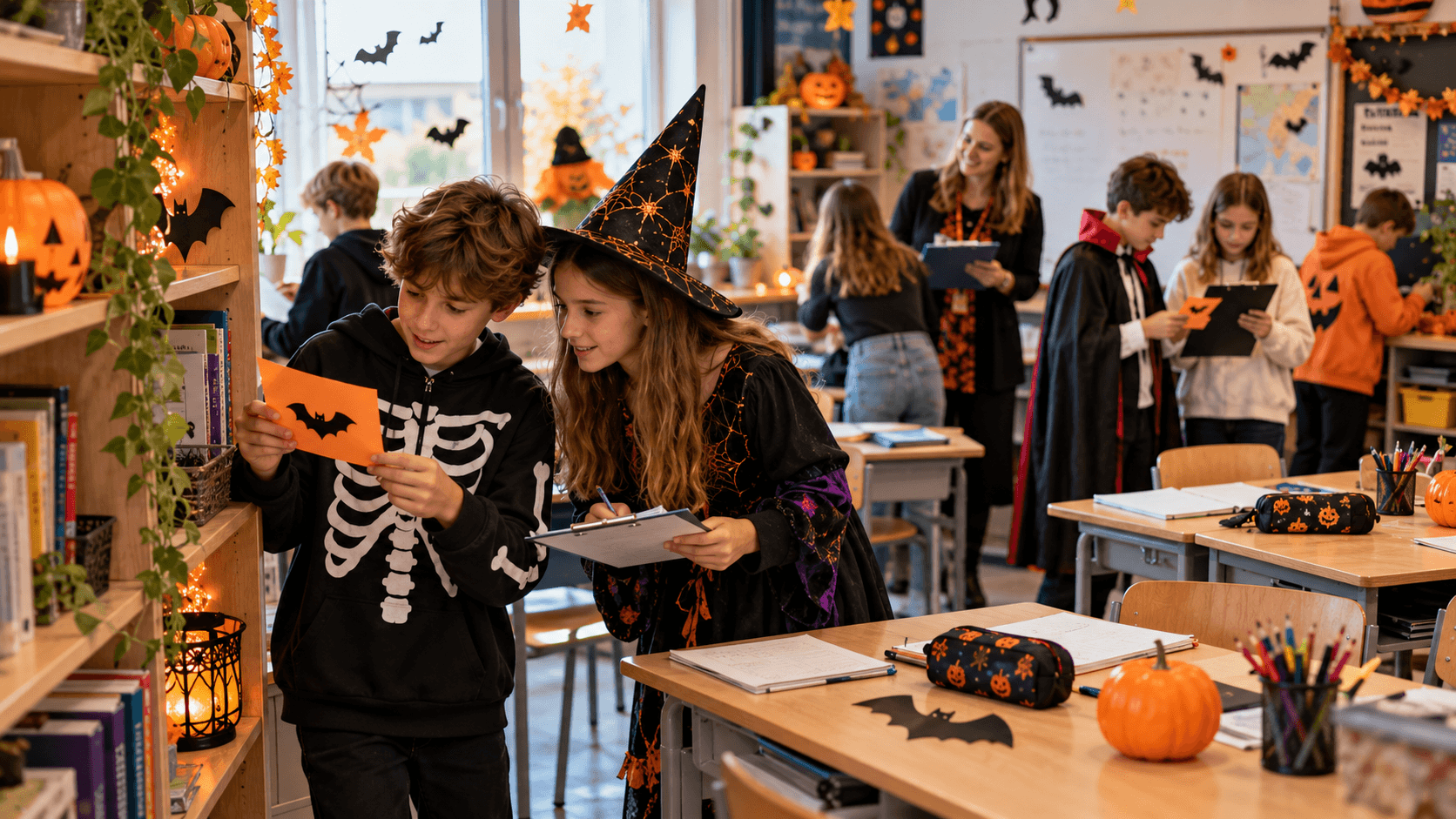
Hide Halloween images, vocabulary cards or clues around the classroom.
Students work in pairs or teams to find them.
Turn it educational by putting a question on every card.
Students only earn the item after solving the question.
For example:
Find the bat card → Name another nocturnal animal.
Now movement and revision happen together.
13. Draw the Monster
Best for: Grades K–8
Time: 10–20 minutes
Prep: Low
Energy: Low
Learning potential: High
One student describes a monster.
Everyone else draws it.
For example:
It has three eyes.
It has two long arms.
It has purple hair.
It has four small ears.
At the end, compare drawings.
This is particularly useful for ESL because students practise:
body parts;
numbers;
colors;
adjectives;
prepositions;
and listening comprehension.
14. Halloween Story Chain
Best for: Grades 3–12
Time: 10–25 minutes
Prep: None
Energy: Low
Learning potential: High
Start a story:
“At midnight, Maya heard something underneath the classroom floor…”
One student adds a sentence.
Then the next.
Continue around the room.
For older students, introduce mandatory words:
pumpkin
mysterious
suddenly
because
although
This turns the activity into vocabulary and grammar practice.
15. Guess the Halloween Sound
Best for: Grades K–6
Time: 10–15 minutes
Prep: Low
Energy: Low
Play or imitate sounds.
Students identify:
a wolf;
an owl;
thunder;
a creaking door;
footsteps;
a cat;
wind.
For younger language learners, students name the source.
Older students can write a sentence describing what they imagine is happening.
16. Pumpkin Math Challenge
Best for: Grades 1–8
Time: 15–30 minutes
Prep: Medium
Energy: Low
Learning potential: High
Bring in a pumpkin.
Ask students to estimate:
its weight;
circumference;
number of seeds;
height;
or how many cubes would approximately equal its volume.
Record predictions.
Then measure.
For older students, turn the measurements into calculations, averages or percentages.
Halloween now becomes a math lesson without pretending it isn't Halloween.
17. Halloween Categories
Best for: Grades 3–12
Time: 10–20 minutes
Prep: None
Energy: Medium
Learning potential: High
Choose a letter.
Then give students categories:
Halloween object.
Animal.
Adjective.
Verb.
Food.
Place.
Students must find a valid answer beginning with that letter.
For example, with B:
Bat.
Black.
Bite.
Brownie.
Basement.
Give bonus points for answers nobody else chose.
18. Who Am I? Halloween Edition
Best for: Grades 3–12
Time: 15–20 minutes
Prep: Low
Energy: Medium
Give each student a Halloween character or creature without letting them see it.
They ask yes-or-no questions:
Am I human?
Can I fly?
Am I scary?
Do I have fangs?
Continue until they identify themselves.
For ESL students, this is excellent practice for question formation.
19. Halloween Word Scramble
Best for: Grades 2–8
Time: 10–15 minutes
Prep: Low
Energy: Low
Learning potential: High
Scramble Halloween vocabulary.
For example:
TSOGH → GHOST
TIWCH → WITCH
TAB → BAT
NPKPMUI → PUMPKIN
Students solve individually or in teams.
Make it harder by asking students to use each solved word in a sentence.
20. Spooky Sentence Challenge
Best for: Grades 3–12
Time: 10–20 minutes
Prep: None
Energy: Low
Learning potential: High
Give students three random Halloween words.
For example:
vampire — homework — refrigerator
They have to create one grammatically correct sentence containing all three.
Older students can compete for:
funniest sentence;
most creative sentence;
best vocabulary;
best story opening.
It's extremely easy to prepare and surprisingly reusable.
21. Pumpkin Relay
Best for: Grades 1–6
Time: 10–20 minutes
Prep: Low
Energy: High
If you have enough safe space, divide students into teams.
Students transport a small pumpkin or lightweight artificial pumpkin through a short course.
They might:
balance it on a tray;
walk around a cone;
carry it with a partner;
or pass it down the team.
This is better suited to a gym, hall or classroom where desks can safely be moved.
Do not sacrifice classroom furniture for Halloween.
22. Halloween Memory Game
Best for: Grades K–6
Time: 10–20 minutes
Prep: Low
Energy: Low
Place several Halloween objects or pictures where students can see them.
Give them 30 seconds.
Cover everything.
Students write down as many items as they remember.
For language classes, spelling counts.
For younger children, they can draw the objects instead.
23. Guess the Teacher's Answer
Best for: Grades 3–12
Time: 10–20 minutes
Prep: None
Energy: Medium
Ask:
What Halloween candy do you think your teacher would choose?
Which Halloween creature does your teacher find scariest?
Which costume would your teacher never wear?
Teams predict your answer.
Then reveal it.
You can reverse the game and predict students' answers.
This requires almost zero preparation and works particularly well with a class you already know.
24. Halloween Debate
Best for: Grades 6–12
Time: 15–30 minutes
Prep: None
Energy: Medium
Learning potential: High
Give students a deliberately debatable statement.
For example:
Halloween costumes should be allowed at school.
Ghosts are scarier than zombies.
Halloween is better than Christmas.
Every student should receive homework on Halloween.
That last one should generate opinions.
Assign positions or let students choose sides.
Give preparation time, then allow each side to make its argument.
For language classes, provide useful phrases:
I agree because…
I disagree because…
In my opinion…
However…
25. Create Your Own Halloween Game Show
Best for: Grades 5–12
Time: 25–45 minutes
Prep: Low
Energy: Medium
Learning potential: Very high
Instead of giving students the questions, let them create them.
Divide the class into small groups.
Each group creates several Family Feud-style questions around:
Halloween;
the current lesson;
school life;
English vocabulary;
science;
history;
or another subject.
They must decide:
the question;
possible answers;
and suggested point values.
Then use the strongest questions in a class game.
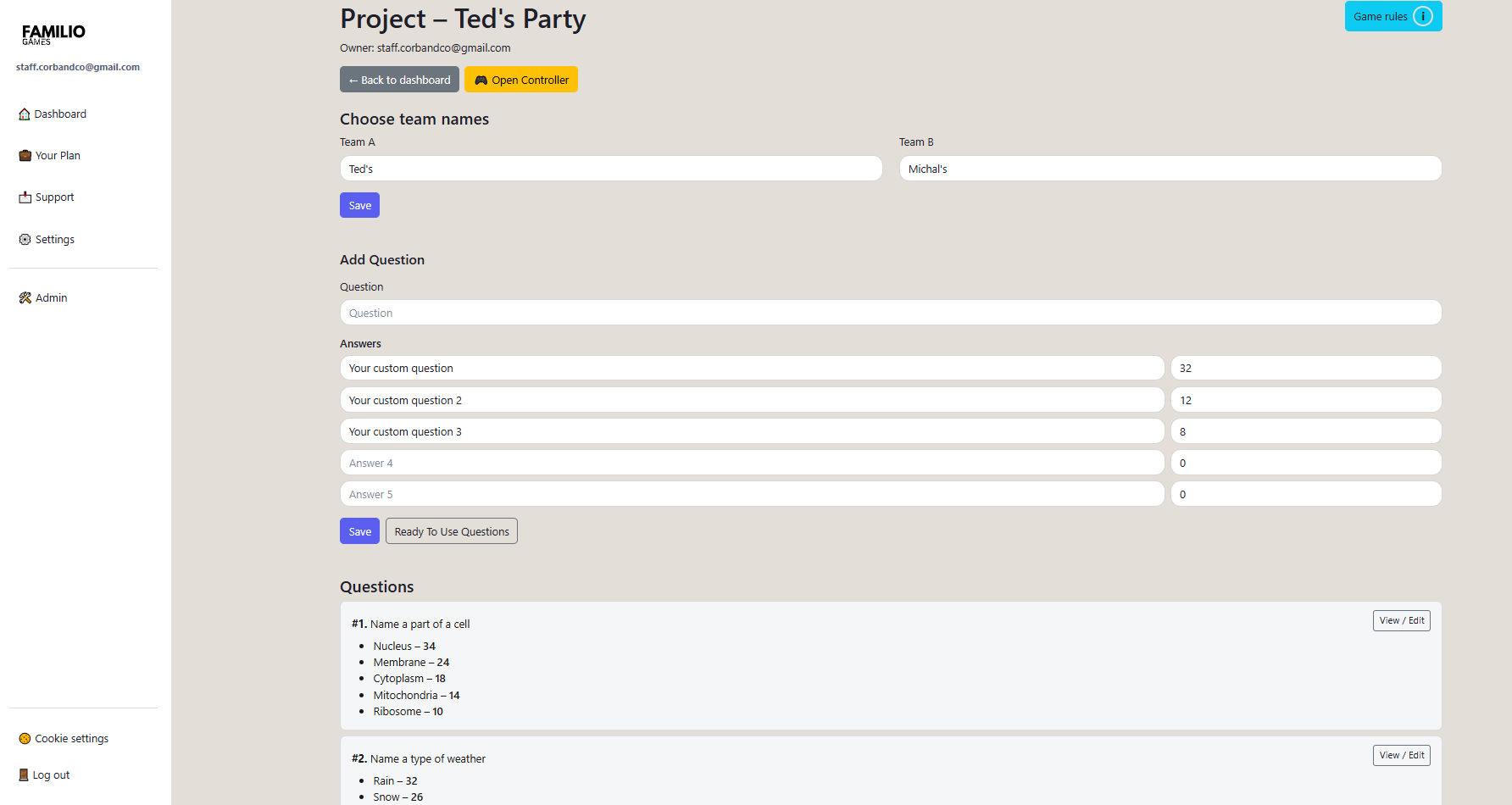
Familio Games lets teachers create custom questions, answers and point values, so student-created rounds can be added to the same game used on the classroom display.
This turns students from contestants into game designers.
And because they have to predict plausible answers, the task requires more thought than simply writing trivia questions.
Best No-Prep Halloween Classroom Games
If Halloween is tomorrow — or, realistically, in fifteen minutes — choose activities that don't require printing, cutting or shopping.
The easiest options from this list are:
Halloween Would You Rather
Halloween Categories
Halloween Story Chain
Spooky Sentence Challenge
Halloween Debate
Guess the Teacher's Answer
You can run any of them using only a whiteboard.
Best Quiet Halloween Classroom Games
Not every Halloween activity needs to increase the volume of the room.
For a calmer lesson, try:
Halloween Bingo
Draw the Monster
Halloween Story Chain
Pumpkin Math
Halloween Word Scramble
Halloween Memory Game
Spooky Sentence Challenge
These work particularly well after a more energetic activity.
Best Active Halloween Classroom Games
If students need to move, choose:
Four Corners
Monster Freeze Dance
Halloween Scavenger Hunt
Pumpkin Relay
Halloween Charades
Whenever movement is involved, check the room first.
Thirty students plus bags, chairs, desks and Halloween excitement can turn a harmless game into an obstacle course you did not intend to create.
Best Educational Halloween Games
Halloween doesn't have to replace learning.
Some of the strongest educational choices are:
Halloween Family Feud — retrieval, discussion and subject review.
5 Second Rule — rapid vocabulary recall.
Draw the Monster — listening and descriptive language.
Pumpkin Math — estimation and measurement.
Halloween Categories — vocabulary retrieval.
Spooky Sentence Challenge — grammar and creative writing.
Halloween Debate — speaking and argumentation.
Create Your Own Game Show — question creation and critical thinking.
Familio Games also has a dedicated Family Feud for Classroom & School setup for teachers who want to turn revision, warm-ups or subject-specific content into a reusable classroom game.
Best Halloween Games by Age
Elementary / Primary School
Prioritize simple rules, movement and visual activities.
Good choices include:
Halloween Bingo.
Draw the Monster.
Monster Freeze Dance.
Halloween Scavenger Hunt.
Mystery Box.
Halloween Memory.
Pumpkin Math.
For younger children, avoid games where students are permanently eliminated.
A six-year-old eliminated in minute two does not magically disappear from your classroom for the remaining eighteen minutes.
Middle School
Students can handle more competition and more complex language.
Try:
Halloween Family Feud.
5 Second Rule.
Pictionary.
Four Corners.
Halloween Categories.
Who Am I?
Spooky Sentence Challenge.
Middle school students often enjoy games significantly more than they are willing to admit.
Proceed accordingly.
High School
Avoid making everything feel designed for small children.
Try:
Halloween Family Feud.
Trivia.
Halloween Debate.
Story Chain.
5 Second Rule.
Categories.
Create Your Own Game Show.
The Halloween theme can be subtle.
Competition and genuinely challenging questions matter more than cartoon ghosts everywhere.
Three Ready-to-Use Halloween Classroom Plans
If You Have 15 Minutes
2 minutes: Explain the game.
10 minutes: Halloween 5 Second Rule or Would You Rather.
3 minutes: Final challenge and wrap-up.
That's enough.
Don't start an elaborate five-round tournament six minutes before the bell.
If You Have 30 Minutes
5 minutes: Halloween Would You Rather warm-up.
20 minutes: Halloween Family Feud.
5 minutes: Final round and scores.
This gives you a simple activity followed by one substantial whole-class game.
If You Have a Full 45-Minute Lesson
5 minutes: Halloween vocabulary warm-up.
25 minutes: Halloween Family Feud with a mixture of seasonal and educational questions.
10 minutes: Spooky Sentence Challenge or Draw the Monster.
5 minutes: Final score, discussion and classroom reset.
For a party rather than a lesson, replace the educational section with charades, bingo or a scavenger hunt.
How to Keep Halloween Games From Becoming Chaos
The difference between a great classroom game and a terrible one is often not the activity.
It's the rules around it.
Explain Before You Start
Don't start the timer and then explain what students are supposed to do.
Demonstrate one example first.
Avoid Long Elimination
If a student is eliminated, they still exist.
Keep everyone involved as:
players;
team advisers;
scorekeepers;
judges;
or future representatives.
Set a Noise Rule
Explain when teams can discuss and when you need silence.
For competitive games, only accept answers from the active representative.
Choose a Stop Signal
Use:
a timer;
a bell;
a countdown;
or a clear verbal signal.
Students should know immediately when discussion stops.
Choose Games That Can End at the Bell
A classroom activity should survive being stopped.
Family Feud can finish after the current board.
Would You Rather can finish after the current question.
Pictionary can finish after the current turn.
A 45-minute scavenger hunt involving twelve interconnected clues is less forgiving.
What If Some Students Don't Celebrate Halloween?
Not every student or family celebrates Halloween.
And not every child enjoys spooky imagery.
You can adapt most games without changing the mechanics.
Replace:
Halloween creatures
with
autumn animals.
Replace:
haunted houses
with
mysterious places.
Replace:
Halloween vocabulary
with
autumn vocabulary.
Pumpkins, leaves, weather, harvest, forests and seasonal colors can replace ghosts, witches and monsters.
Students who don't want to participate in a themed activity can also take roles such as scorekeeper, host assistant or judge where appropriate.
The game should create inclusion.
Not require everyone to feel exactly the same way about Halloween.
Halloween Classroom Party or Halloween Lesson?
It can be either.
For a classroom party, prioritize:
movement;
teamwork;
laughter;
short rules;
and variety.
For a Halloween lesson, prioritize:
vocabulary;
retrieval;
speaking;
problem solving;
writing;
and subject review.
The best activities can do both.
A Halloween Family Feud board can contain Halloween questions for the first round and science revision questions for the next.
A Halloween Categories game can practise vocabulary.
A spooky story can practise past tenses.
A pumpkin can become a math investigation.
You don't necessarily have to choose between Halloween fun and learning.
Want One Game to Run on the Classroom Screen?
If you want one activity to become the main event rather than running several small stations, a game-show format works particularly well.
Familio Games lets the teacher keep a private controller on their laptop while students see a separate game board on the projector, television or interactive classroom display.
Teachers can use ready-to-play questions or create their own educational rounds around mathematics, English, science, history, geography and other lesson topics.
The Halloween Edition keeps the same hosting system but adds seasonal visuals, Halloween questions, themed sounds and pumpkin strike animations.
That means you can start with:
Name something you might see in a haunted house.
Then move to:
Name an animal that is nocturnal.
Then:
Name a country in Europe.
Same game.
Different learning goal.
Create a classroom game with Familio Games and turn your next review lesson into a game show.
Frequently Asked Questions
What are the best Halloween classroom games?
Good whole-class choices include Halloween Family Feud, 5 Second Rule, Pictionary, trivia, Four Corners and Would You Rather. For younger students, Bingo, Draw the Monster, scavenger hunts and movement games also work well.
What are some no-prep Halloween classroom games?
Halloween Would You Rather, Categories, Story Chain, Spooky Sentence Challenge, Guess the Teacher's Answer and Halloween Debate can all be played with little or no preparation.
What Halloween games are educational?
Family Feud-style review games, vocabulary races, Draw the Monster, Pumpkin Math, Categories, sentence challenges, debates and student-created game shows can all connect Halloween with academic skills.
What Halloween classroom games work for elementary students?
Bingo, Mystery Box, Monster Freeze Dance, Draw the Monster, scavenger hunts, Halloween Memory and simple Family Feud questions work particularly well for younger students.
What Halloween games work for middle school?
Middle school students can play Halloween Family Feud, 5 Second Rule, Pictionary, Four Corners, trivia, Categories, Who Am I? and creative sentence games.
What Halloween games work for high school students?
Try more competitive or discussion-based games such as Halloween Family Feud, trivia, debates, 5 Second Rule, Categories, Story Chain and student-created game-show rounds.
How many Halloween games do I need for one class period?
For a normal lesson, two or three activities are usually enough. A short warm-up followed by one substantial whole-class game and a brief closing activity can fill a 30–45 minute period without feeling rushed.
How can I make Halloween classroom games less chaotic?
Choose team formats, explain rules before starting, avoid long elimination, establish a stop signal and use games that can be ended cleanly when the lesson finishes.
Can I play Halloween classroom games on a projector or interactive whiteboard?
Yes. Trivia, Pictionary and game-show activities work particularly well on a shared classroom display. Familio Games uses a separate teacher controller and audience display, allowing students to see the game board while answers and controls remain private.