
Halloween Family Feud for the Classroom: Questions, Rules and Teacher Tips
Halloween at school creates an interesting challenge.
Students are excited.
Costumes may be involved.
Concentration is... negotiable.
And you're somehow expected to turn all that energy into something resembling a lesson.
Halloween Family Feud can help.
Instead of asking students to sit quietly through another worksheet, divide the class into teams and turn your classroom screen into a Halloween game board.
Students discuss answers, practice vocabulary, recall information and compete as teams — while you remain in control of the questions, scoring and pace.
You can use it purely as a Halloween classroom game or adapt the format for English, vocabulary, science, history and lesson review.
Here's how to set it up.

What Is Halloween Family Feud for the Classroom?
Halloween Family Feud is a classroom version of the familiar survey-style guessing game.
The teacher asks a question such as:
Name something you might find inside a haunted house.
Several answers are hidden on the board.
Students try to predict them.
For example:
Ghost
Spider
Skeleton
Cobweb
Bat
Correct guesses reveal answers and score points.
Incorrect guesses earn strikes.
The goal isn't simply to know a fact.
Students have to think about which answers other people are most likely to give.
That difference makes Family Feud particularly useful for vocabulary, speaking and discussion activities.
Why Does Family Feud Work in the Classroom?
The format solves several problems teachers encounter with classroom games.
Students play as teams
A student doesn't need to perform alone for the entire class.
They can discuss possibilities with teammates and contribute when they're ready.
Everyone can think about the same question
Even when one student is giving the final answer, the rest of the class can be considering possible responses.
The difficulty is easy to change
You can ask:
Name something orange.
Or:
Name an adjective that could describe a haunted house.
Or:
Name a nocturnal animal.
The game mechanic stays the same.
The learning level doesn't.
It feels different from a worksheet
The screen, hidden answers, points and strikes create anticipation.
Students aren't completing question number seven because it's next on the page.
They're trying to beat the other team.
That can make a surprisingly large difference.
What Do Teachers Need?
A classroom version can be extremely simple.
You need:
- two teams;
- one teacher or student host;
- several questions;
- answers for each question;
- a scoring system;
- and a board everyone can see.
You can create the board manually with slides or paper.
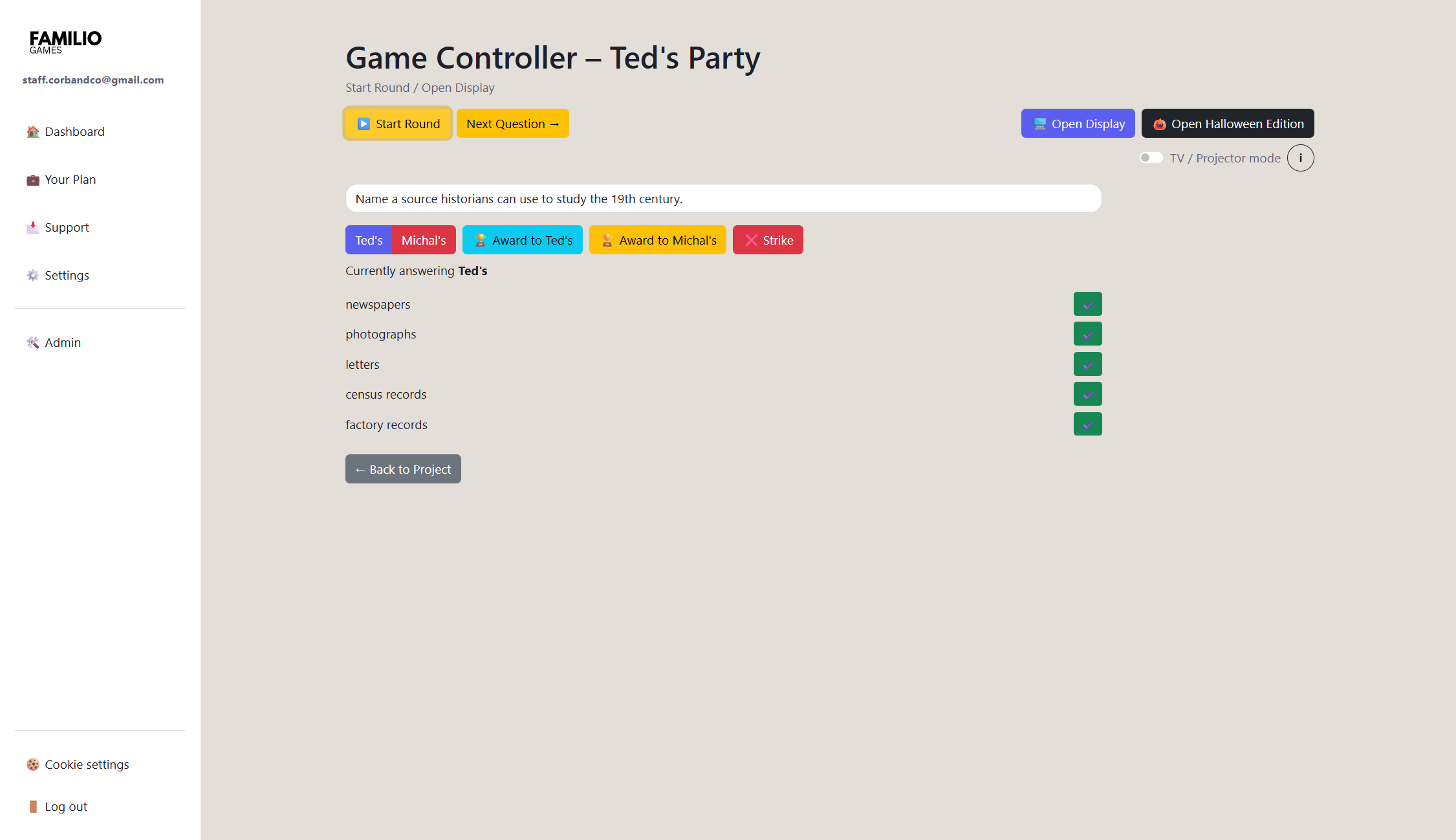
Alternatively, a browser-based setup lets the teacher control the game from a laptop while students see a separate audience display on the classroom screen.
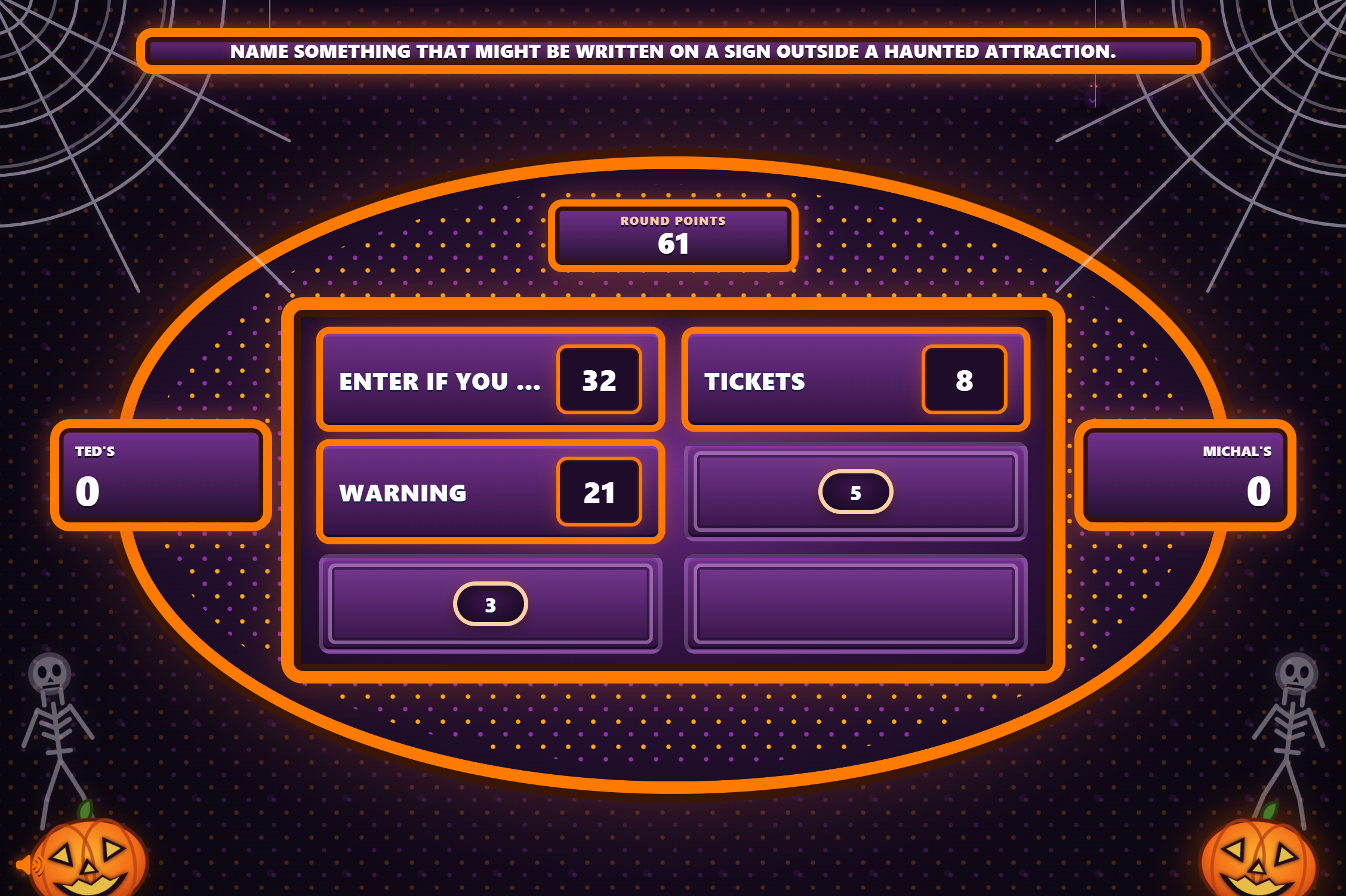
Familio Games includes separate host and audience views, so the teacher can see the controls and hidden answers without revealing them to the class.
Its Halloween Edition also adds seasonal visuals, spooky sounds and Halloween-ready questions.
How to Set Up Halloween Family Feud in the Classroom
You don't need to rearrange your classroom into a television studio.
A simple setup works.
Teacher laptop
Keep the controller on your laptop.
Ideally, position the laptop so students cannot see the private controls or hidden answers.
Classroom screen
Open the audience display on your interactive whiteboard, projector or large television.
Students should see the board clearly from their seats.
Two teams
Split the class approximately in half.
You can keep existing table groups together or quickly count students into two teams.
Halloween team names make the setup more fun:
Witches vs Vampires
Ghosts vs Zombies
Pumpkins vs Skeletons
Trick vs Treat
One clear playing area
For face-offs, choose one representative from each team and have them answer from their seats or come to the front.
Don't create complicated classroom movement unless you actually need it.
The game should make classroom management easier, not turn your room into an airport terminal.

Classroom Halloween Family Feud Rules
Traditional Family Feud rules can be simplified for school.
Here's a classroom-friendly version.
1. Divide the Class Into Two Teams
Try to keep the teams reasonably balanced.
For younger students, the teacher can choose the teams.
Older students can sometimes choose their own, but you already know whether that's a good idea with your particular class.
2. Choose One Player From Each Team
Start each round with one representative from each team.
Read the question aloud.
You can let students raise their hands, use classroom buzzers or simply alternate which representative answers first.
3. Reveal the Stronger Answer
If both students provide valid answers, the team with the higher answer takes control of the round.
4. Let the Team Guess
Students take turns suggesting answers.
Correct answer?
Reveal it and add the points.
Incorrect answer?
Add a strike.
5. Three Strikes Means a Steal
After three incorrect guesses, give the other team a chance to discuss.
They provide one final answer.
If it's still hidden on the board, they steal the round.
If not, the original team keeps the points.
6. Rotate Players
Don't let the same confident students answer every question.
Rotate representatives so different students get opportunities to participate.
For larger classes, this matters much more than following traditional television rules perfectly.
Your goal is classroom participation.
Not broadcast accuracy.
15 Halloween Family Feud Questions for the Classroom
Here are 15 ready-to-use questions suitable for a broad range of school-age students.
The point values below are suggested gameplay values, not results from an independent survey of 100 people.
Adjust answers, vocabulary and difficulty for your students.
1. Name something you associate with Halloween.
- Pumpkin — 28
- Costume — 22
- Candy — 18
- Ghost — 12
- Witch — 8
2. Name something orange.
- Orange fruit — 29
- Pumpkin — 26
- Carrot — 16
- Fire — 9
- Autumn leaves — 7
3. Name something you might see in a haunted house.
- Ghost — 29
- Spider — 20
- Skeleton — 16
- Cobweb — 12
- Bat — 7
4. Name an animal associated with Halloween.
- Bat — 28
- Spider — 23
- Black cat — 18
- Owl — 10
- Snake — 7
5. Name something a witch might have.
- Broomstick — 28
- Hat — 21
- Cauldron — 16
- Black cat — 12
- Magic wand — 8
6. Name something people wear on Halloween.
- Costume — 35
- Mask — 21
- Makeup — 14
- Hat — 10
- Cape — 7
7. Name something children might receive while trick-or-treating.
- Chocolate — 31
- Candy — 28
- Lollipop — 12
- Gummies — 8
- Small toy — 5
8. Name something that might scare you.
- Spider — 25
- Snake — 20
- Darkness — 17
- Ghost — 13
- Loud noise — 8
9. Name something you can do with a pumpkin.
- Carve it — 34
- Eat it — 20
- Decorate it — 17
- Paint it — 11
- Make pumpkin pie — 7
10. Name a word that describes a haunted house.
- Scary — 31
- Dark — 21
- Creepy — 17
- Old — 10
- Haunted — 8
11. Name something you might hear on Halloween night.
- Scream — 25
- "Trick or treat!" — 21
- Laughter — 16
- Spooky music — 12
- Doorbell — 8
12. Name something that flies and seems spooky.
- Bat — 39
- Owl — 21
- Witch — 16
- Ghost — 9
- Crow — 6
13. Name something you might find in a Halloween classroom.
- Decorations — 28
- Pumpkins — 21
- Costumes — 17
- Candy — 12
- Halloween pictures — 7
14. Name something people decorate for Halloween.
- House — 30
- Pumpkin — 26
- Classroom — 12
- Garden — 9
- Door — 7
15. Name something students would rather do than homework on Halloween.
- Trick-or-treat — 29
- Go to a party — 21
- Watch a movie — 18
- Eat candy — 13
- Play games — 8
Want more rounds?
Our collection of 60 Halloween Family Feud questions and answers includes additional categories covering costumes, trick-or-treating, spooky situations, parties, kids and funny Halloween questions.
Turn Halloween Family Feud Into an English Lesson
This is where the format becomes much more useful than simply filling time before Halloween.
For an English or ESL classroom, design boards around language production.
Adjectives
Ask:
Name an adjective that could describe a haunted house.
Possible answers:
Scary.
Dark.
Creepy.
Old.
Mysterious.
Students are recalling vocabulary while trying to predict which words appear on the board.
Halloween Vocabulary
Ask:
Name something associated with a witch.
or:
Name something you might find in a haunted house.
For younger learners, the questions reinforce familiar nouns.
For stronger students, require them to use the answer in a sentence before revealing it.
Verbs
Ask:
Name something a ghost might do.
Possible answers might include:
Float.
Disappear.
Scare.
Scream.
Haunt.
Now the game is practising verbs without looking like a verb exercise.
Speaking
Before accepting an answer, require students to say:
“I think the answer is…”
or:
“Our team thinks people would say…”
For more advanced students:
“We chose this answer because…”
One simple rule turns a guessing game into repeated speaking practice.
Use Halloween Family Feud for Lesson Review
Halloween questions aren't your only option.
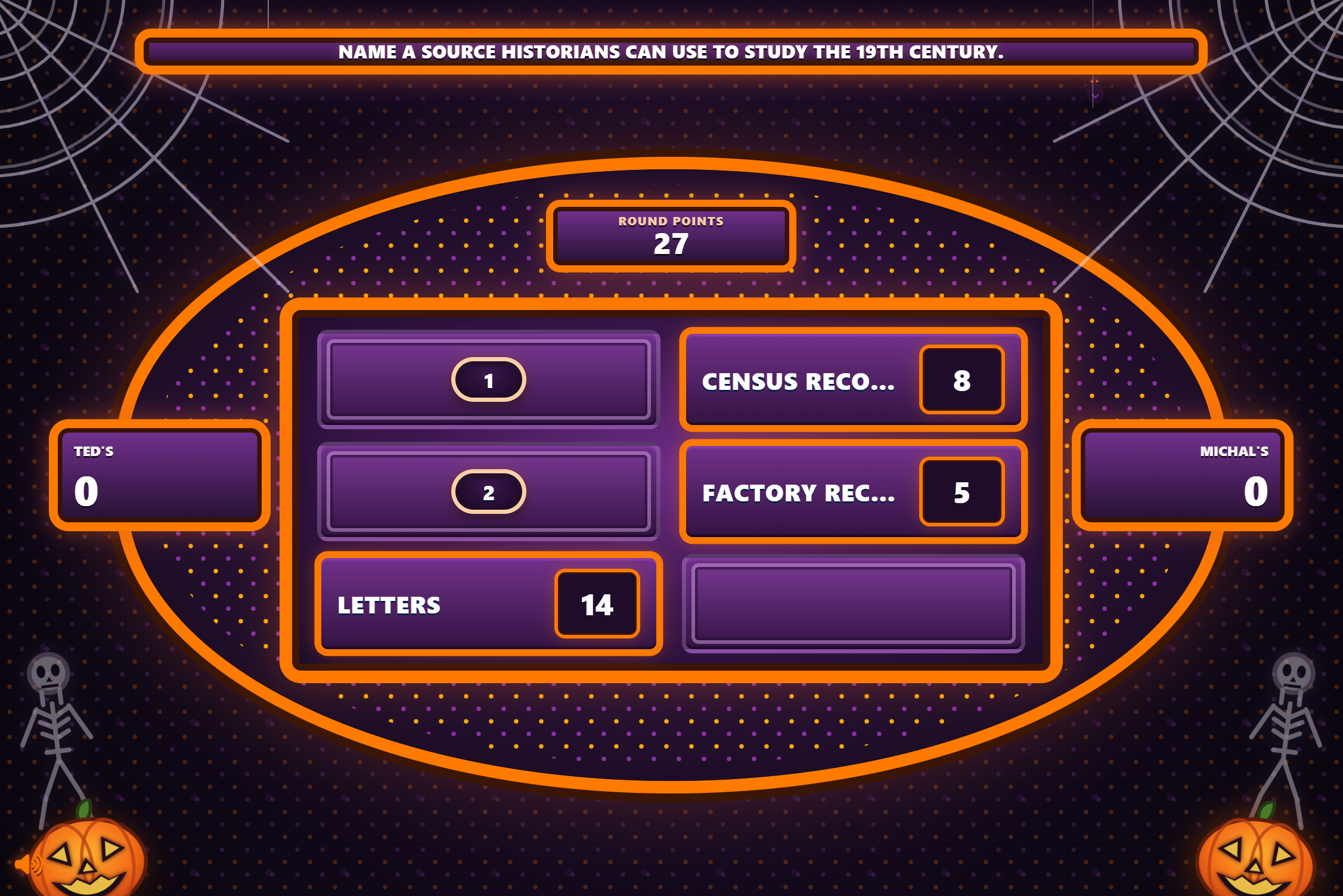
Keep the Halloween game board and replace the content with material students are already studying.
A science teacher could ask:
Name an animal that is nocturnal.
A geography teacher could ask:
Name a country in Europe.
A history teacher could ask:
Name something associated with Ancient Egypt.
An English teacher could ask:
Name an irregular verb beginning with S.
A younger primary class could answer:
Name something that is usually red.
The Halloween theme creates the atmosphere.
The questions can still teach whatever you need them to teach.
How to Adapt the Game by Age
A question that works beautifully with eight-year-olds can be painfully easy for sixteen-year-olds.
Adapt the content rather than abandoning the format.
Elementary / Primary School
Keep questions concrete and visual.
Try:
Name something orange.
Name a Halloween costume.
Name an animal that comes out at night.
Use fewer answers per board if necessary.
Give students more discussion time.
And don't eliminate children from the game.
Middle School
Introduce more vocabulary, reasoning and humour.
Try:
Name something people pretend not to be afraid of.
Name something you shouldn't do in a haunted house.
Name something that makes a good Halloween costume.
Students can also create questions themselves.
High School
Use more abstract questions and subject-specific content.
Try:
Name something that creates suspense in a horror story.
Name a superstition people still believe.
Name an adjective that describes fear.
You can also let students create complete boards including possible answers and suggested point values.
That turns them from players into game designers.
How Many Questions Do You Need for One Lesson?
Don't prepare 30 rounds for a 45-minute lesson.
You will never reach them.
For a 10-minute activity, prepare approximately 3 questions.
For 20 minutes, use approximately 5–6 questions.
For a full 45-minute lesson, around 8–10 questions is usually plenty once you include instructions, discussion, scoring and transitions.
If you're using the game for revision, fewer questions with meaningful discussion may be more valuable than racing through twenty boards.
How to Keep Every Student Involved
The biggest classroom-game problem isn't usually the game.
It's the same four students answering everything.
Here are several ways to prevent that.
Rotate Representatives
A student who has already represented the team can't do another face-off until others have participated.
Give Teams Discussion Time
Allow five or ten seconds before the final answer.
Now several students contribute even when one person speaks.
Use Team Captains Carefully
Captains can submit final answers, but rotate the role between rounds.
Award Participation Points
If necessary, give small bonus points for good explanations, vocabulary or complete English sentences.
Ask Follow-Up Questions
After revealing an answer, ask:
Why do you think this answer scored highly?
Now the board becomes a discussion prompt.

Should Students Use Buzzers?
They can.
They don't have to.
For face-offs, you can use:
- physical classroom buzzers;
- raised hands;
- desk bells;
- a simple hand signal;
- or alternate which team answers first.
Don't let equipment become a barrier.
If buying buzzers takes longer than preparing the entire lesson, you've probably overengineered Halloween.
Should You Give Prizes?
Optional.
For younger students, small prizes can increase excitement.
They don't need to be expensive.
Try:
- stickers;
- Halloween pencils;
- small certificates;
- classroom privileges;
- choosing the next warm-up activity.
If your school permits candy, that's another obvious option.
But the game should still work without prizes.
Competition, points and the final score are usually enough.
Classroom Management Tips
A good classroom game should create controlled excitement.
Not chaos.
Explain the Rules Before Starting
Don't explain rules while students are already shouting answers.
Show one practice question first.
Establish a Noise Rule
Tell teams when discussion is allowed and when you need silence.
Don't Allow Shouting Answers From the Audience
If students can yell answers whenever they want, the board will last approximately twelve seconds.
Only accept answers from the active player or team representative.
Keep the Pace Moving
Don't spend five minutes debating whether an answer is technically equivalent to another answer.
You're the host.
Make a reasonable decision and continue.
Finish Before the Energy Disappears
If students are still asking for another round when the bell rings, the game worked.
That's better than squeezing in four extra questions until everyone wants it to end.
What If I Don't Have Time to Build the Game?
You can run Family Feud manually.
But creating slides, hiding answers, tracking points and managing strikes can turn a simple classroom activity into considerably more preparation than expected.
A browser-based game removes much of that work.
With Familio Games, teachers can use existing questions or create their own, control the board from a private host view and display the student-facing game separately.
For Halloween, the Halloween Edition adds seasonal visuals and effects without requiring you to redesign your presentation.
That makes it particularly useful when you want the classroom to feel different for Halloween without spending the evening before building forty animated slides.
Can You Play Halloween Family Feud Online?
Yes.
If you're teaching remotely or have students joining online, you can keep the controller private and share only the audience display.
The basic structure stays the same:
Teacher controls the game.
Students see the board.
Teams discuss answers.
For the full technical setup, our guide to hosting Family Feud online explains how to organize the screens and run the game remotely.
Halloween Family Feud vs Other Classroom Games
Family Feud isn't the only Halloween classroom activity worth using.
For younger students, movement games, scavenger hunts and Halloween Bingo can be excellent.
For older students, trivia, Pictionary and timed word games work well.
Family Feud is strongest when you want:
- team discussion;
- vocabulary production;
- whole-class participation;
- a game visible on the classroom screen;
- customizable lesson content;
- or a larger activity that can become the centre of the lesson.
For more alternatives, our guide to the best Halloween party games for adults, kids and families includes several games that can also be adapted for school.
A Ready-to-Use 45-Minute Halloween Lesson
Need something you can actually use tomorrow?
Here's one structure.
0–5 minutes — Introduce the Game
Divide the class into two teams.
Explain the rules.
Play one easy practice board.
5–15 minutes — Easy Halloween Rounds
Use three simple questions.
Focus on familiar vocabulary.
15–30 minutes — Learning Rounds
Switch to questions connected with your subject.
For an English class, use vocabulary, verbs and adjectives.
For another subject, use relevant lesson-review questions.
30–40 minutes — Challenge Rounds
Introduce more difficult questions or double the points.
Rotate students who haven't participated yet.
40–45 minutes — Final Round
Finish with one strong Halloween question.
Reveal the final score.
And ideally leave yourself enough time to calm everyone down before sending them into the corridor.
Ready to Turn Your Classroom Into a Halloween Game Show?
Halloween doesn't have to mean choosing between a normal lesson and forty-five minutes of chaos.
A good classroom game can do both jobs.
Students get competition, teams, Halloween visuals and something genuinely different from an ordinary lesson.
You still get vocabulary practice, speaking, recall, discussion and control over the content.
With Familio Games, you can use ready-made Halloween questions or create your own educational rounds, control everything privately from your laptop and show students a separate game board on the classroom screen.
No manually hiding answers.
No complicated scoring spreadsheet.
No rebuilding your presentation every time you want to change a question.
Just choose your teams, open the board and start the first round.
Play Halloween Family Feud in your classroom with Familio Games.
Frequently Asked Questions
How do you play Halloween Family Feud in the classroom?
Divide students into two teams, ask a Halloween survey-style question and let students guess the hidden answers. Correct guesses score points, incorrect answers earn strikes, and after three strikes the opposing team can attempt to steal the round.
Is Halloween Family Feud educational?
It can be. Teachers can use Halloween vocabulary or replace the questions with subject-specific material for English, science, history, geography and other lessons.
What age is Halloween Family Feud suitable for?
The format can be adapted from primary/elementary school through high school. Younger students need simpler, concrete questions, while older students can use more complex vocabulary and subject-specific content.
How many questions do I need for a classroom Family Feud game?
Around 3 questions can fill a short 10-minute activity, while approximately 8–10 questions are usually enough for a full lesson once discussion, scoring and transitions are included.
Do I need buzzers to play Family Feud in class?
No. Teachers can use raised hands, desk bells, classroom buzzers or simply alternate which team answers first.
Can I create my own classroom Family Feud questions?
Yes. Custom questions are particularly useful for lesson review because the same game format can be adapted to vocabulary, grammar, science, history and almost any other subject.
Can Halloween Family Feud be played on a classroom projector?
Yes. A game board can be displayed using a projector, interactive whiteboard or large classroom screen. With a separate host view, the teacher can keep answers private while students see only the audience board.
Can I play Halloween Family Feud with a large class?
Yes. Divide the class into two large teams and rotate representatives between rounds. Short team-discussion periods allow more students to participate without requiring everyone to answer individually.
Where can I find more Halloween Family Feud questions?
Our collection of 60 Halloween Family Feud questions and answers includes ready-to-use rounds covering classic Halloween topics, costumes, trick-or-treating, spooky situations, parties and family-friendly questions.