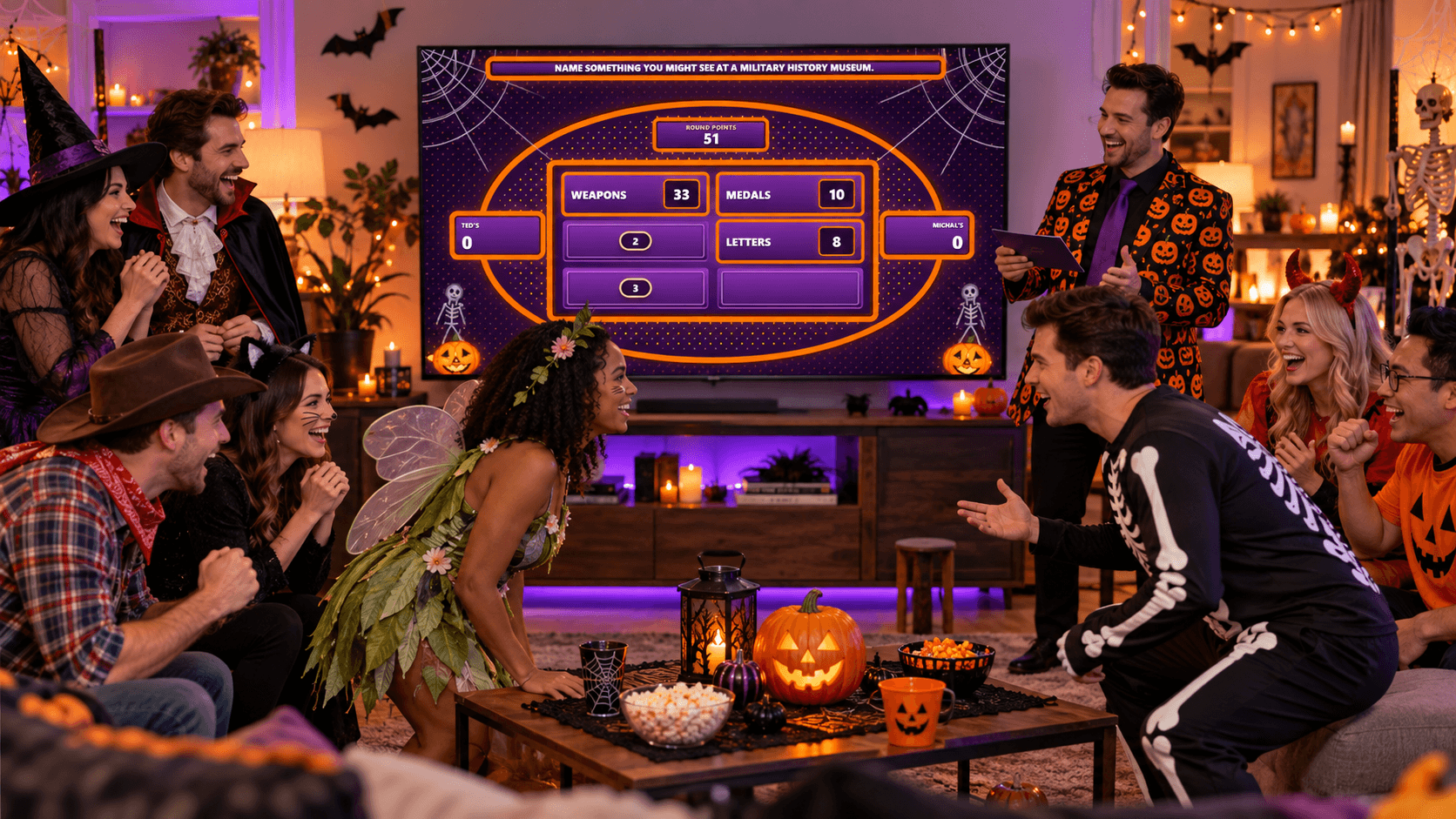
Halloween Family Feud: The Ultimate Guide to a Spooky Game Night
Costumes? Ready.
Pumpkins? Carved.
Enough candy to survive until Christmas? Probably.
But once everyone has arrived, admired the decorations and judged each other's costumes, your Halloween party still needs one important thing:
Something everyone can actually do together.
Halloween Family Feud turns your party into a spooky game show where witches, vampires, skeletons and suspiciously low-effort "people wearing normal clothes" compete to uncover the most popular answers on the board.
It works for families, adults, kids, classrooms, office parties and large groups. Better still, nobody needs specialist horror-movie knowledge to participate.
Here's how to host a Halloween Family Feud game night people will actually remember.
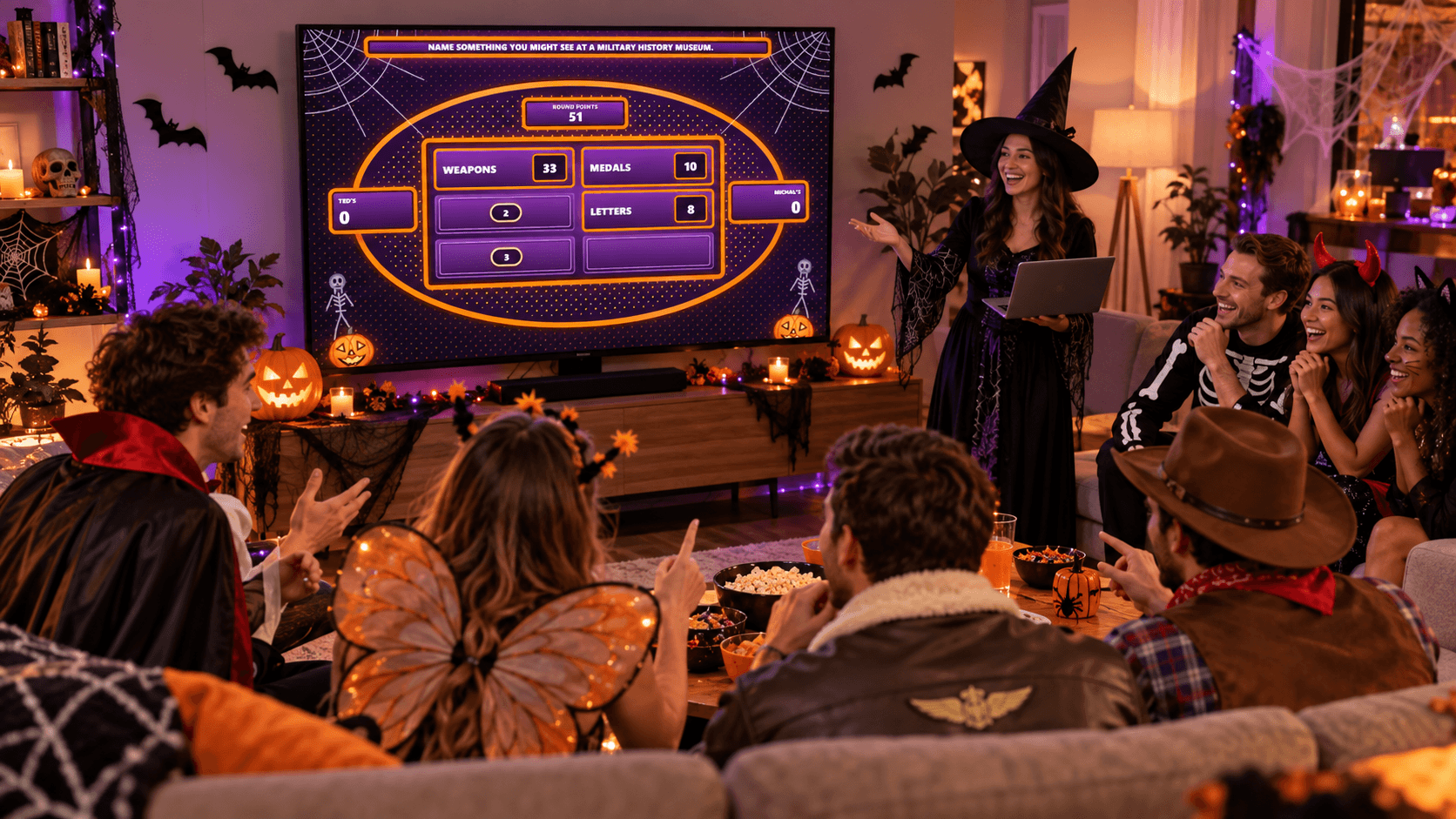
What Is Halloween Family Feud?
Halloween Family Feud takes the familiar survey-style guessing format and gives the entire experience a spooky twist.
Instead of asking:
Name something people take on vacation.
you might ask:
Name something you would hate to find under your bed at night.
Or:
Name something you might see inside a haunted house.
Or:
Name a Halloween costume people are tired of seeing.
Two teams compete to uncover the answers hidden on the board.
Correct answers earn points.
Wrong answers earn strikes.
After three strikes, the opposing team may get an opportunity to steal the round.
The rules are simple enough that new players can understand them within minutes.
The arguments over whether "spider" absolutely should have been the number-one answer may take considerably longer.
Why Family Feud Works So Well for Halloween Parties
Halloween creates an unusual party problem.
The theme does much of the work before anyone arrives.
You decorate the room.
Everyone puts on a costume.
People arrive, admire each other, take photos and grab something to eat.
And then?
A good party activity needs to bring people together without forcing anyone into an uncomfortable spotlight.
That is where Family Feud works particularly well.
Players compete as teams, so quieter guests can participate without performing alone in front of everyone.
The questions are based on familiar situations rather than obscure knowledge.
Nobody gets permanently eliminated after one mistake.
And the game naturally creates conversation.
One person gives an answer.
Their teammates immediately have opinions about it.
The other team desperately hopes it is wrong.
Then everyone watches the board.
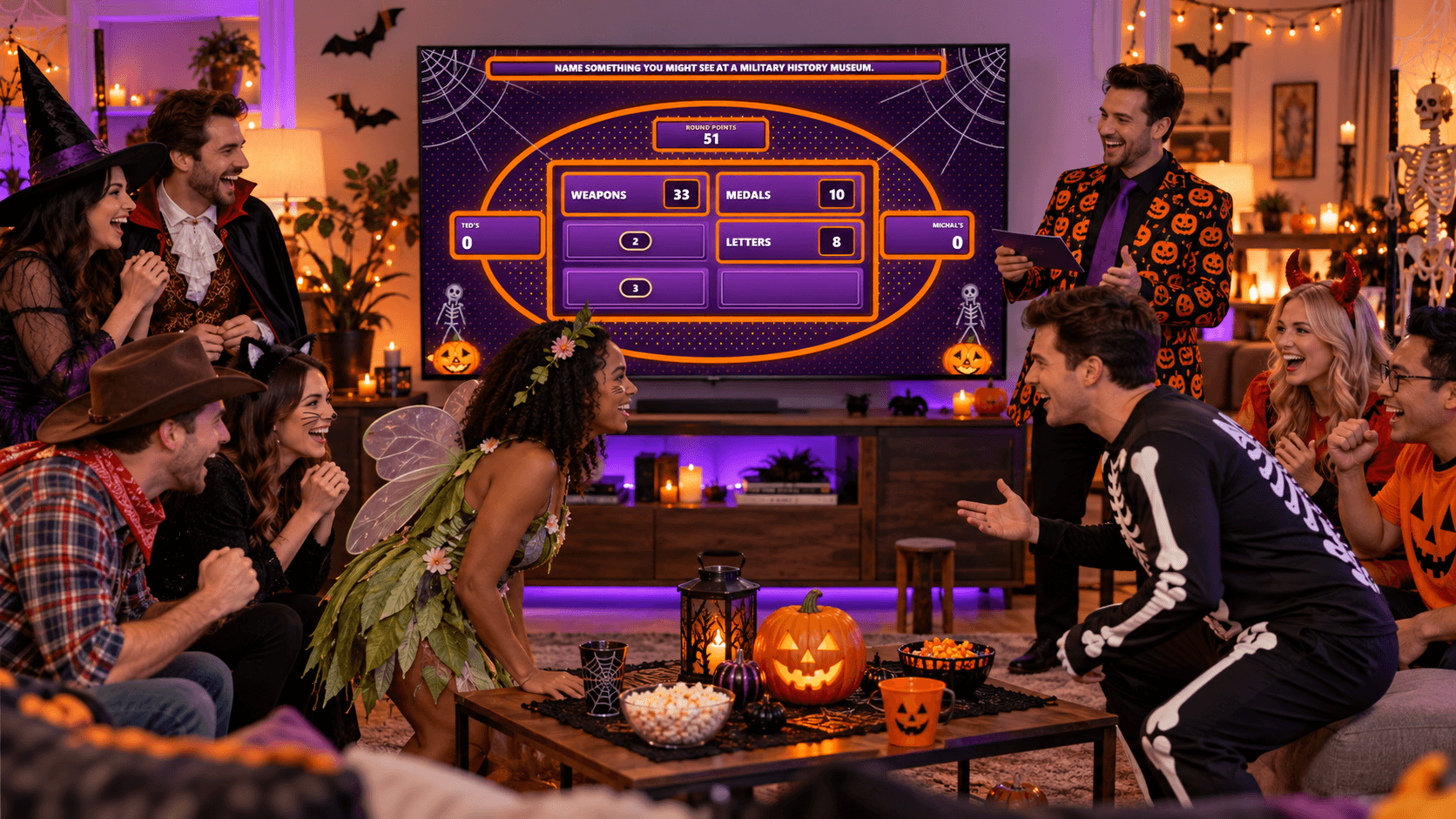
Unlike traditional Halloween trivia, players don't need to know which actor appeared in a particular horror film or when a movie was released.
They simply need to think:
What would most people say?
That makes Halloween Family Feud accessible to a much wider group.
What Do You Need to Play?
You don't need a television studio.
For a basic Halloween Family Feud game, you need:
- one host;
- two teams;
- Halloween-themed questions;
- several possible answers for each question;
- point values;
- a screen or board everyone can see;
- and a way to keep score.
You can create everything manually using paper, presentation software or homemade cards.
Or you can use an online Family Feud-style game platform to handle the board, answer reveals, strikes and scoring.
With Familio Games, the host gets private game controls while players see a separate audience display.
For Halloween, the game can also use the dedicated Halloween Edition with spooky visuals and Halloween-themed effects.
That means you can spend more time choosing your costume and less time constructing a game board.
How to Set Up Halloween Family Feud
Step 1: Choose a Host
The host controls the pace of the game.
They read questions, accept answers, reveal the board, add strikes and keep score.
Choose someone who is comfortable speaking to the group and willing to keep things moving.
And because this is Halloween, the host has one advantage over an ordinary game night:
the costume can become part of the performance.
A vampire game-show host works.
A skeleton in a bow tie works.
A completely serious presenter wearing an enormous pumpkin hat may work even better.
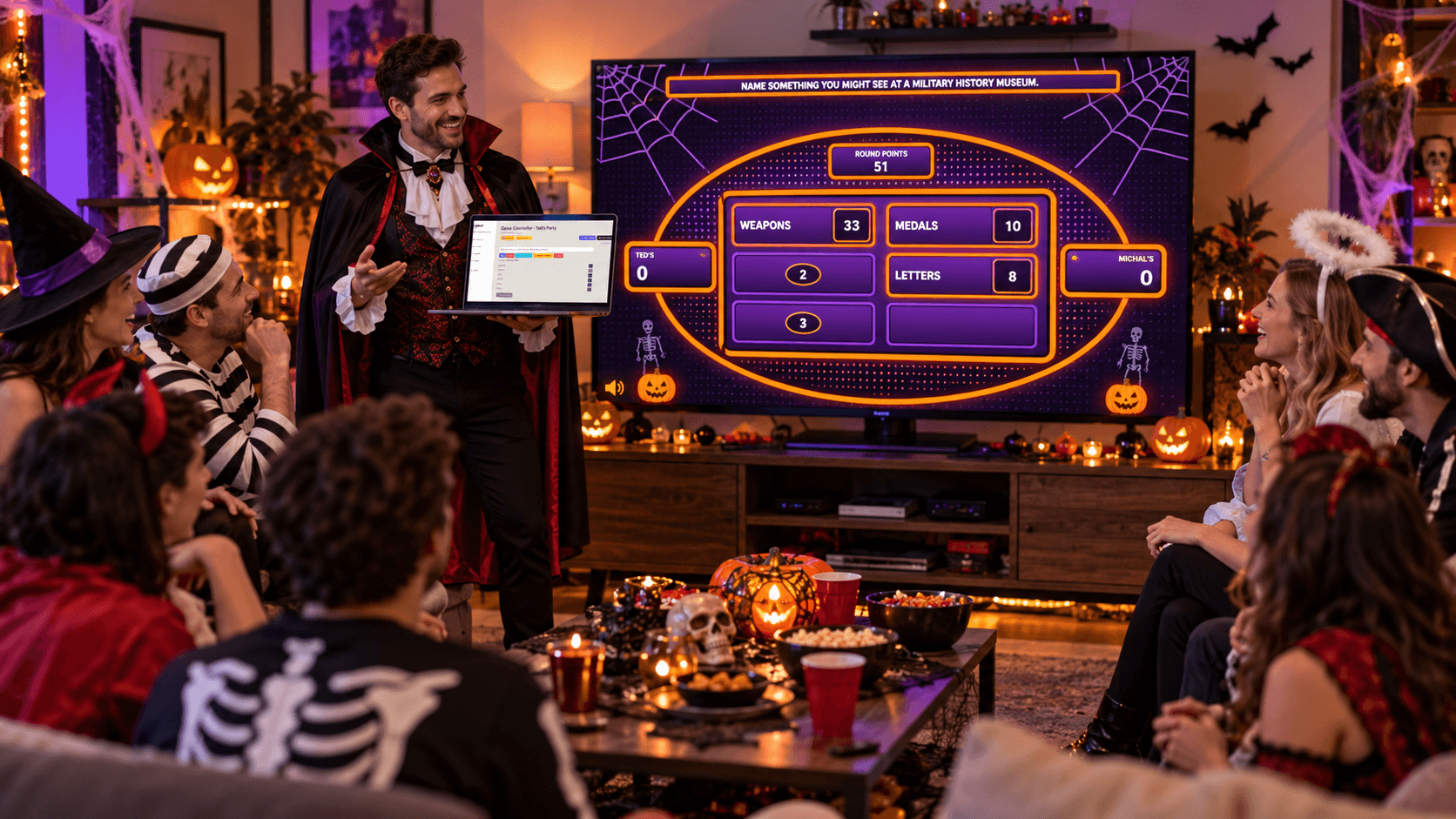
The host doesn't need to become a professional entertainer. A little enthusiasm and suspense before revealing an answer can transform the atmosphere.
Step 2: Create Two Teams
You don't need exactly five players on each side.
Adapt the teams to your group.
You can divide people randomly or turn the team names into part of the theme:
Witches vs Vampires
Ghosts vs Zombies
Monsters vs Humans
Trick vs Treat
Pumpkins vs Skeletons
For a larger party, create two bigger teams and rotate which players represent them during each round.
Step 3: Choose Your Questions
Good Halloween Family Feud questions should immediately give players ideas without making every answer obvious.
For example:
Name something people are afraid of.
Name something you might find in a witch's house.
Name a popular Halloween costume.
Name something you might see in a haunted house.
Name something that could wake you up in the middle of the night.
Each question can produce several plausible responses.
That's important because Family Feud is not ordinary trivia.
There shouldn't usually be one objectively correct answer.
The challenge is predicting which answers are most likely to appear on the board.
Don't Turn It Into a Horror Movie Quiz
Halloween doesn't automatically mean horror trivia.
If every question requires knowledge of specific films, actors or fictional characters, some players will dominate while others stop participating.
Instead, mix categories.
Good Halloween themes include:
- costumes;
- candy;
- monsters;
- pumpkins;
- trick-or-treating;
- fears;
- superstitions;
- haunted houses;
- autumn;
- spooky situations;
- Halloween parties;
- witches;
- ghosts;
- Halloween movies.
A few movie-related questions are great.
Twenty consecutive horror-film questions are a quiz wearing a Family Feud costume.
How Many Questions Do You Need?
Probably fewer than you think.
For a short party game, 5–7 rounds can be enough.
For a dedicated game night, prepare approximately 8–12 rounds.
Having additional questions ready gives you flexibility, but you don't need to play every question you prepare.
Watch the room.
If everyone is shouting answers and demanding another round, continue.
If half the players mysteriously migrate toward the snack table whenever a new question appears, start heading toward the finale.
The best party game ends while people still want another round.
How to Play Halloween Family Feud
Once everyone understands the basic idea, the game is straightforward.
Start With a Face-Off
Choose one player from each team.
The host reads the question.
Both players attempt to give a strong answer.
The team with the better answer can take control of the board.
Reveal the Board
Players on the team in control take turns guessing the hidden answers.
Correct answer?
Reveal it and add the points.
Wrong answer?
Strike.
Three Strikes
After three incorrect guesses, the team loses its opportunity to clear the board.
And now things become interesting.
Give the Other Team a Chance to Steal
The opposing team gets one chance to provide a remaining answer.
They can quickly discuss their options before giving the host their final guess.
If it appears on the board, they can steal the round.
If it doesn't, the original team keeps the points.
Ten seconds of a team desperately debating whether "clown" is still hiding on the board can become surprisingly dramatic.
Make Wrong Answers Part of Halloween
A normal strike works.
A Halloween strike is better.
The wrong-answer moment is already one of the most recognizable parts of this type of game, so Halloween gives you an opportunity to make it part of the atmosphere.
Use spooky sounds.
Halloween animations.
Pumpkin-inspired effects.
Or simply make the host dramatically delay the reveal.
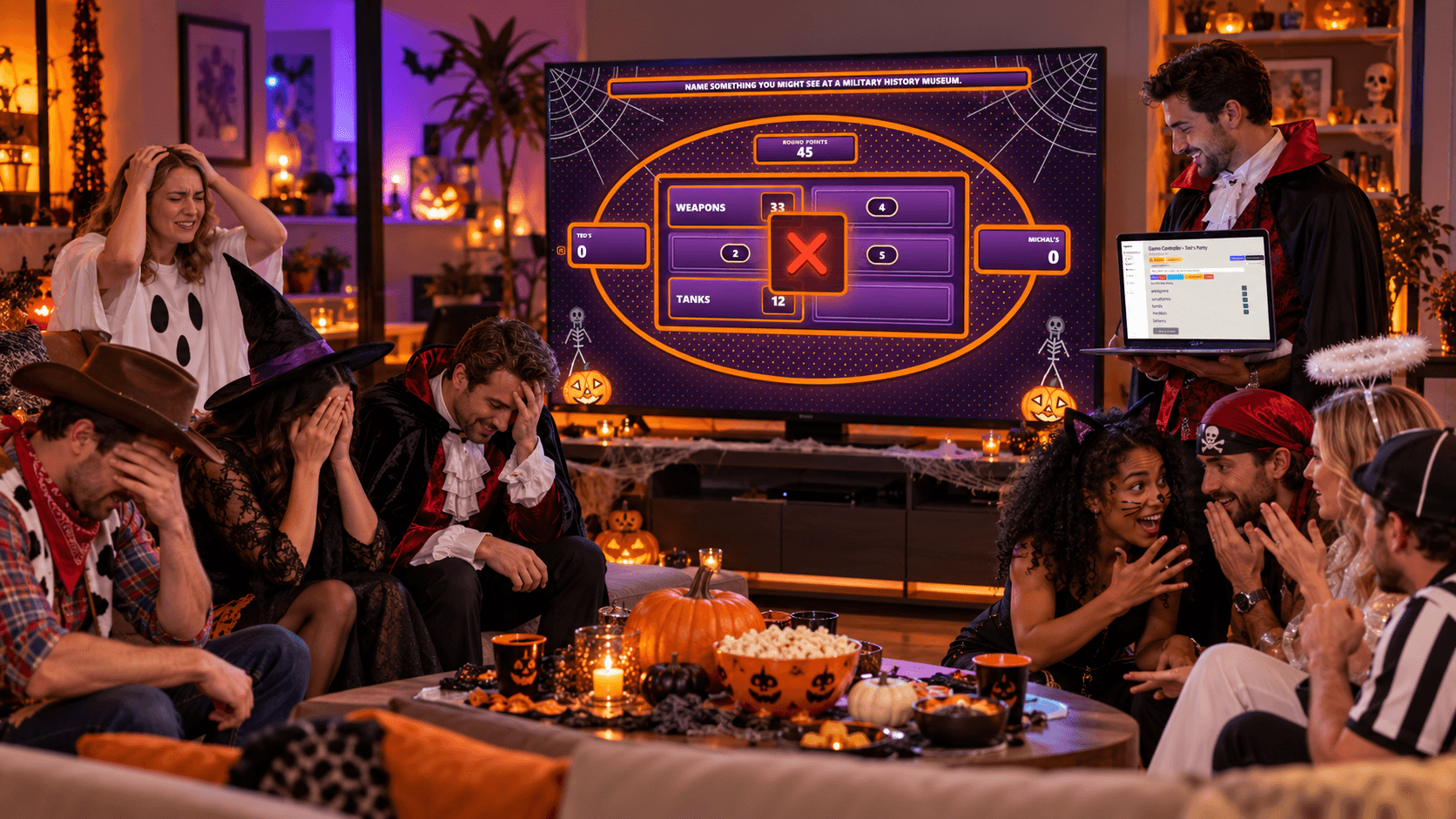
With Familio Games' Halloween Edition, the seasonal game skin can carry the Halloween theme into the game itself instead of leaving it only in the room decorations.
That creates a much more coherent experience when the board is displayed on a large television or projector.
Halloween Family Feud Questions
You can create all of the questions yourself or use ready-made rounds.
Here are five examples to start with.
1. Name something you might see inside a haunted house.
Possible answers could include:
- Ghost
- Skeleton
- Spider
- Cobweb
- Bat
2. Name something people are afraid of.
Possible answers could include:
- Spiders
- Snakes
- Darkness
- Ghosts
- Heights
3. Name something associated with a witch.
Possible answers could include:
- Broomstick
- Black cat
- Cauldron
- Pointed hat
- Spells
4. Name something people do at a Halloween party.
Possible answers could include:
- Wear costumes
- Eat candy
- Play games
- Dance
- Take photos
5. Name a popular Halloween costume.
Possible answers could include:
- Witch
- Vampire
- Ghost
- Zombie
- Skeleton
These are only examples.
For a full game, use our dedicated collection of 50+ Halloween Family Feud Questions and Answers.
That resource focuses entirely on ready-to-use questions, while this guide focuses on actually hosting the event.
Halloween Family Feud for Kids
For younger children, keep the questions visual and easy to understand.
Good examples include:
Name something you put in a trick-or-treat bag.
Name an animal that seems spooky.
Name something orange.
Name something you might dress up as for Halloween.
Name something you see on Halloween decorations.
You can also simplify the rules.
Give teams slightly longer to discuss.
Use fewer answers on each board.
Skip complicated face-off rules if they slow the game down.
And consider giving several small prizes rather than making everything depend on the final score.
Candy has been known to produce impressive levels of motivation.
Halloween Family Feud for Teens
Teenagers can handle more difficult and humorous questions.
Topics might include:
- embarrassing costumes;
- horror movies;
- Halloween parties;
- social media;
- haunted houses;
- fears;
- Halloween trends;
- trick-or-treating when you're supposedly "too old."
You can even let players submit custom questions before the event.
Just review them first.
A little editorial control can prevent a surprisingly long conversation later.
Halloween Family Feud for Adults
Adult games give you considerably more freedom.
You can introduce questions about parties, dating, embarrassing situations, terrible costumes and irrational fears.
For example:
Name something you would pretend not to be afraid of on a first date.
Or:
Name something that makes a terrible last-minute Halloween costume.
Just remember who is actually playing.
A Halloween house party with close friends and an office party attended by someone's manager require very different definitions of "adult humour."
Halloween Family Feud for the Classroom
Halloween can also become an opportunity for classroom engagement.
Divide students into two teams and display the game board on a classroom television, interactive board or projector.
You can use ordinary Halloween questions for a fun classroom celebration.
Or connect the questions to learning.
For English:
Name an adjective that could describe a haunted house.
For science:
Name an animal associated with Halloween.
For vocabulary:
Name a word connected with witches.
For younger students:
Name something orange.

The competition gives students a reason to participate while the questions can reinforce vocabulary, general knowledge or material they are already learning.
For a complete classroom setup, see our dedicated guide to Halloween Family Feud for the Classroom.
Halloween Family Feud at Work
Halloween Family Feud can also work well for office parties and team-building events.
Mix general Halloween rounds with a few workplace questions.
For example:
Name something people in the office are more afraid of than ghosts.
Name something that mysteriously disappears from the office kitchen.
Name something scarier than receiving an email saying "Can we talk?"
Company-specific questions can be particularly entertaining because everyone understands the reference.
Keep them playful rather than personal.
The goal is team building.
Not an unexpected meeting with HR.
How to Play With a Large Group
You can scale the format to much larger events.
If you have 20, 30 or 50+ participants, don't try to give every player an individual answer during every round.
Instead:
- divide everyone into two large teams;
- rotate representatives between rounds;
- allow short team discussions;
- keep the audience involved;
- keep the board visible to everyone.
For large events, pacing becomes especially important.
The host should explain less and play more.
We'll cover the format in detail in our guide to Family Feud for Large Groups.
Turn Your TV Into a Halloween Game Board
For a home party, one of the easiest setups is:
Laptop → host controls
Television → audience board
The host keeps answers and controls private.
Players see only the Halloween game board.
In a classroom or office, the television can simply become a projector or large presentation screen.
With Familio Games, the controller and audience display are separated specifically so the host can manage the game without accidentally showing the answers to everyone else.
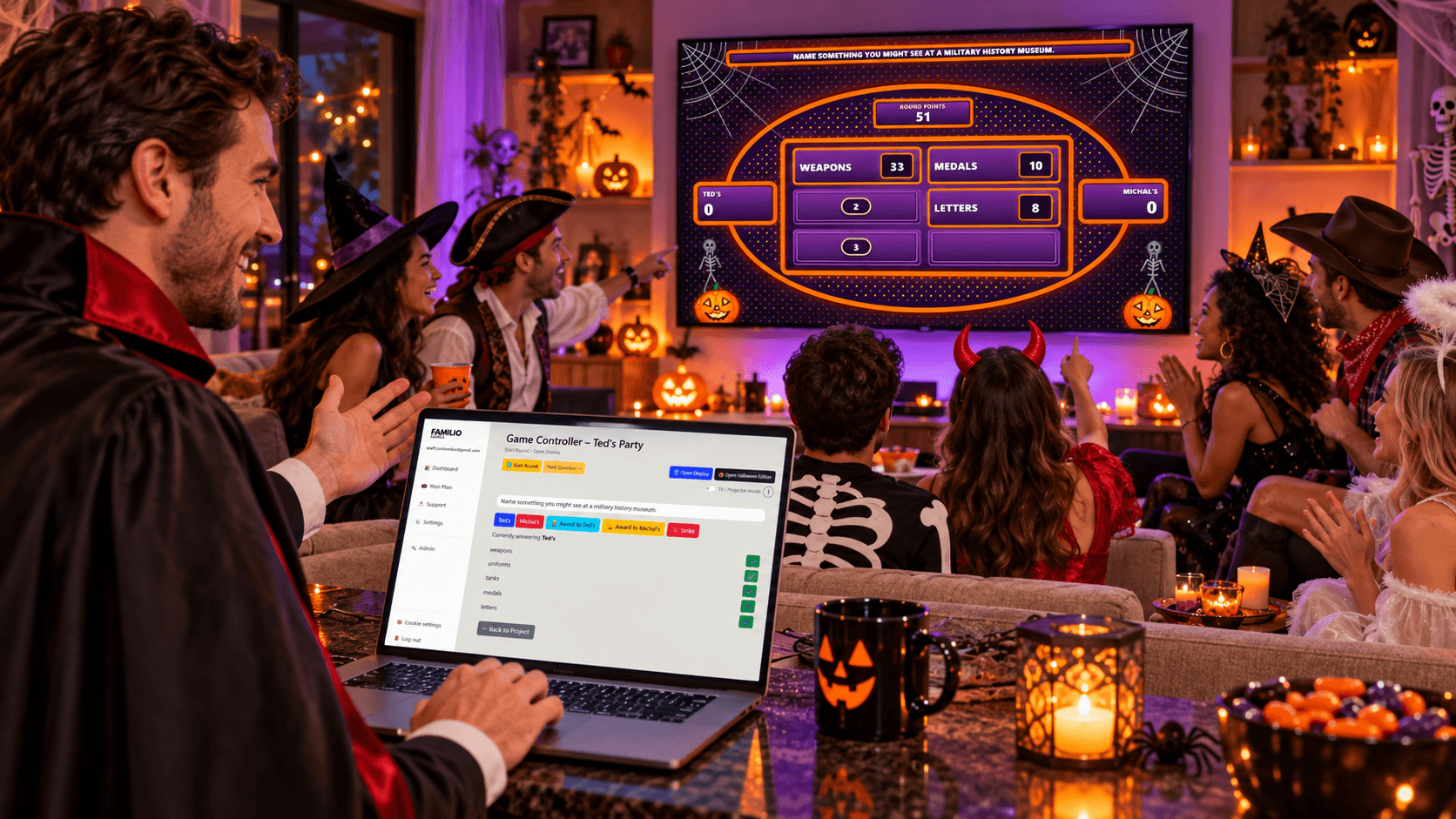
This is especially useful for Halloween because the audience screen becomes part of the decoration.
Put a few pumpkins around the TV.
Add artificial cobwebs around the surrounding furniture.
Use subtle orange or purple lighting.
Just don't decorate directly over the screen.
Atmosphere is good.
A giant plastic spider covering answer number three is less useful.
Add a Costume Contest
If everyone has already dressed up, make the costumes part of the event.
Halfway through the game, pause for a quick costume vote.
Possible awards include:
Best Costume
Funniest Costume
Scariest Costume
Most Creative Costume
Best DIY Costume
and, if your group appreciates it:
Lowest-Effort Costume That Somehow Still Works
Then return to Family Feud.
The short break changes the pace and gives everyone another reason to participate.
Give the Winners Something
Prizes don't need to be expensive.
Halloween gives you plenty of easy options:
- candy;
- chocolate;
- mini pumpkins;
- Halloween mugs;
- novelty decorations;
- funny homemade trophies;
- small gift cards;
- winner-chooses-the-next-game privileges.
For children, several small prizes can work particularly well.
For adults, a ridiculous homemade trophy may create considerably more competition than its financial value would suggest.
Combine Family Feud With Other Halloween Games
For a longer event, Halloween Family Feud doesn't need to carry the entire evening.
Mix formats.
For example:
Costume contest → Halloween Family Feud → food break → Halloween 5 Second Rule → Family Feud finale
Changing games keeps the evening fresh.
Familio Games also includes a 5 Second Rule-style game, so the same event can switch from survey-style guessing to fast-paced three-answer challenges.
We'll cover that separately in our Halloween 5 Second Rule Questions and Challenges guide.
A Simple 60-Minute Halloween Game Night Plan
Don't want to plan the schedule yourself?
Try this.
0–10 minutes: Arrival
Let everyone settle in, grab snacks, admire costumes and choose teams.
10–15 minutes: Explain the game
Introduce both teams and play one easy practice question.
15–30 minutes: First rounds
Play approximately three or four Halloween Family Feud rounds.
30–35 minutes: Costume contest
Vote, announce winners and take photos.
35–50 minutes: Main game
Introduce slightly harder questions and your best custom round.
50–60 minutes: Finale
Finish with one or two strong questions and announce the winning team.
If everyone wants to continue, you already have extra questions prepared.
Make Some Questions Personal
Ready-made Halloween questions make preparation easy.
But a few custom questions can make the game unforgettable.
For a family:
Name something Dad would be terrified to find in the basement.
For friends:
Name someone here most likely to survive a zombie apocalypse.
For coworkers:
Name something in this office that would make a terrible Halloween costume.
These questions work because the answers mean something specifically to the people in the room.
With Familio Games, you can combine ready-made Halloween questions with your own custom rounds inside the same project.
Can You Play Halloween Family Feud Online?
Yes.
The players don't need to be in the same room.
For a virtual Halloween party, the host keeps the game controls private and shares only the audience display through the video call.
Everyone can still dress up.
Everyone can still compete.
Everyone can still argue about the answers.
And nobody has to clean fake cobwebs out of somebody else's carpet afterwards.
For the full technical setup, read our guide to hosting a Family Feud game online.
Ready for Halloween?
A Halloween party already gives you costumes, decorations and atmosphere.
What it often needs is something that turns a room full of people into a group actually doing something together.
Halloween Family Feud gives everyone the same question to think about, the same board to watch and a team to support.
You can build everything manually.
Or you can use Familio Games' Halloween Edition, choose ready-to-play questions, add your own rounds and control the game from a separate host screen while everyone else watches the Halloween board.
Then there is only one important decision left.
Witches vs Vampires?
Ghosts vs Zombies?
Trick vs Treat?
We'll leave that one to you.
Start your Halloween Family Feud game with Familio Games.
Frequently Asked Questions
What is Halloween Family Feud?
Halloween Family Feud is a Halloween-themed version of a survey-style team guessing game. Players try to uncover popular answers to questions about costumes, candy, monsters, fears, haunted houses and Halloween traditions.
How many Halloween Family Feud questions do I need?
Around 5–7 questions can work for a short party activity. For a longer dedicated game, preparing approximately 8–12 rounds gives the host more variety and flexibility.
Is Halloween Family Feud suitable for kids?
Yes. Use simple questions about costumes, candy, pumpkins, animals and decorations, and simplify the rules for younger children if necessary.
Can adults play Halloween Family Feud?
Absolutely. Adult games can use more difficult questions and humour involving parties, dating, horror movies, embarrassing costumes and everyday fears.
Can teachers use Halloween Family Feud?
Yes. Teachers can use it purely as a Halloween activity or adapt questions to practise English, vocabulary, science and other classroom subjects.
Can you play Halloween Family Feud at work?
Yes. Combine general Halloween questions with lighthearted workplace-themed rounds for an office party or team-building event.
Can you play Halloween Family Feud online?
Yes. Keep the host controls private and share the audience-facing game board through your video-call platform.
Where can I find Halloween Family Feud questions?
Familio Games includes ready-to-play Halloween content, while our dedicated 50+ Halloween Family Feud Questions and Answers guide provides additional questions and ideas for building your game.